
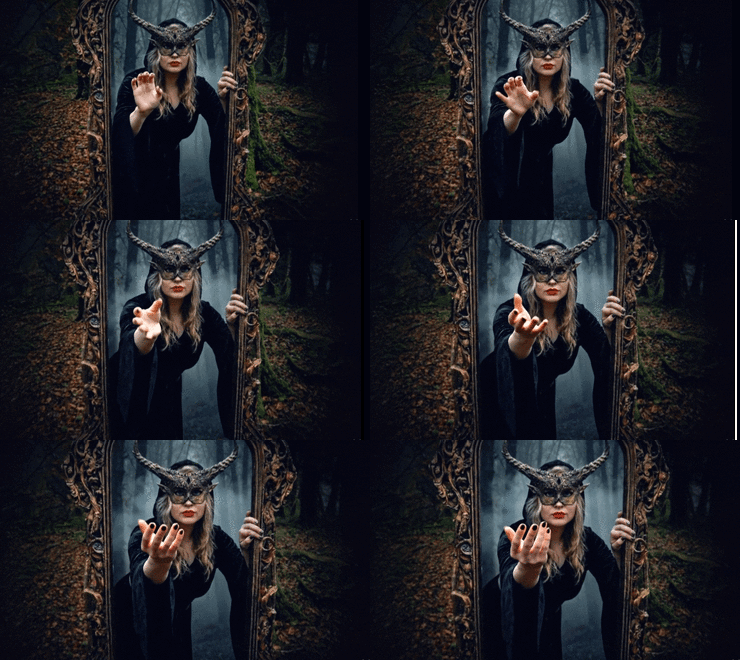

Press Play. 🎧🎶
Do not leave your window open
Don’t invite the voice within
Do not sleep beneath the moonlight
Else you’ll let the Mara in
Place the iron ‘neath your pillow
Hang the rowan o’er your bed
Say a prayer and close the shutters
Else she’ll fill your night with dread
Lulla, lulla, lilla vän
Now the day is at an end
Lulli, lulli, lulla-lay
Close your eyes and float away
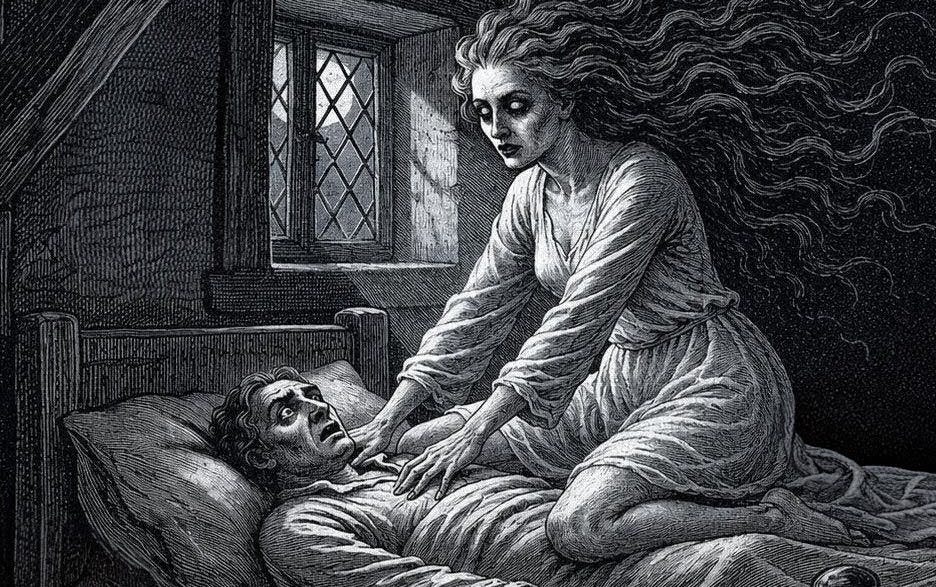
Mara, Mara, on your chest
Bringing terror to your rest
Mara, Mara, now she rides
Pressing hard against your sides
Mara, Mara, young and fair
Moonlight in her golden hair
Mara, Mara, old as death
Frozen stare and stolen breath
As you lie upon your mattress
Frosted window, room goes cold
See a shadow at your bedside
Bound and helpless in her hold
Trapped beneath her crushing beauty
Cannot move or speak or scream
Heartbeat pounding, cold sweat streaming
As she haunts your waking dream
Lulla, lulla, lilla vän
Now the day is at an end
Lulli, lulli, lulla-lay
Close your eyes and float away
Mara, Mara, on your chest
Bringing terror to your rest
Mara, Mara, now she rides
Pressing hard against your sides
Mara, Mara, young and fair
Moonlight in her golden hair
Mara, Mara, old as death
Frozen stare and stolen breath
Come the morning you awaken
Bruised and aching in your chest
Eyes are bleary with exhaustion
Mara has denied you rest
Perhaps this evening you’ll remember
All the steps that you must take
To keep the Mara from your bedside
So you’ll sleep and safely wake
Lulla, lulla, lilla vän
Now the day is at an end
Lulli, lulli, lulla-lay
Close your eyes and float away
Mara, Mara, on your chest
Bringing terror to your rest
Mara, Mara, now she rides
Pressing hard against your sides
Mara, Mara, young and fair
Moonlight in her golden hair
Mara, Mara, old as death
Frozen stare and stolen breath
About the Mara
In Scandinavian folklore, the Mara was a female night spirit believed to visit sleepers, sit or ride upon their chests, steal their breath, and fill their sleep with terrifying dreams. Her victims might awaken unable to move or speak, conscious of a presence in the room and an unbearable weight pressing upon them. These experiences are now associated with sleep paralysis.
She did not solely torment humans. The Mara was also said to ride animals, particularly horses, through the dark hours. A horse found in its stall at dawn exhausted, sweating, and with its mane twisted into knotted “mare-locks” was believed to have been ridden by the spirit all night.
The Mara could be imagined as young and beautiful, old and monstrous, or something shifting between the two. In some regional tales, the Mara was not a demon but the wandering spirit of an ordinary living woman, leaving her body at night to haunt others, sometimes without her waking knowledge.
Her name survives in the word nightmare. The “mare” was originally not a horse or merely a frightening dream, but the supernatural visitor believed to cause it. This ancient origin is still visible in modern Scandinavian languages, including Swedish mardröm, meaning “mare-dream,” and Norwegian mareritt, meaning “mare-ride.”
This song reimagines that old belief as a dark Scandinavian lullaby, a warning to close the shutters, protect the bed, and never invite the voice in.
If you have enjoyed my work here in the Labyrinth, please consider becoming a free or paid subscriber. If you prefer a one-time offering, you may “buy me a rose” and I would be most grateful. 🥀


What makes this so effective is the contrast between the tenderness of a lullaby and the terror of what it is actually warning us about. The repeated “Lulla, lulla” almost offers safety, while Mara keeps returning with the inevitability of something ancient that cannot simply be explained away. I also loved discovering how deeply her presence survives inside the very word nightmare. A beautifully unsettling piece of folklore brought back to life. 🥀
I've heard enough "true" stories like this that it's truly terrifying.