This was beautiful. I loved how the story transformed what first seemed like a curse into a relationship with the living world. The reveal that Rootvein wasn’t a disease but a symbiosis completely reframed everything that came before it.
“The roots really do remember.” That line hit me the hardest. It felt like the entire heart of the story.
Your worldbuilding is extraordinary, but what stays with me most is Xanthe finally realizing she was never broken only misunderstood. What a wonderful speculative fairytale. 🌿🖤
This is pretty good. The descriptions and characterizations build good depth, and you leave plenty of room for the reader to imagine around the corner. I also want to call out how well you balanced the stakes, which is something I think even well established writers get wrong kind of a lot. The world you describe has rules which we immediately pick up on: the imaginable bigotry or a small society, giant moths and extinct chickens, exotic traders with interesting wares. The fact that she goes out on her quest out of curiosity and not because of some emergency or immediate necessity lets the growth center on her entirely, without having to worry about responsibility to the plot.
Because this was a quiet task though, the reader never has to wait for it to start or get good. With higher stakes, the story would hinge on "Did she win?" But as it is, if you had stopped at the medical facility with her going home after learning about herself: good story. If she had pressed on, found the botanical lab alone, scooped up the flowers, and gone home: good story. If she meets Tiresias and he says they're all leaving forever, but now she knows they exists: still... good story. All of it together though means she gets a quest, faces challenges, expands her world, achieves her goal, and gives us a idea of what she'll do next.
While connecting with the audience. In 3500 words.
So, pretty good.
Have you read much by Terry Brooks? The way you blend genres and build the world out of personal perspective reminds me of his writing.
I appreciate this excerpt as an effective "primer" to a setting: who are the main characters, what's the world they inhabit, and where's the story going to be traveling next. I say effective because there's a schema that's building up that grounds us as readers into what you're speaking about, rather than nebulous names and vague descriptions. That can be challenging with fantasy since there's so much one wants to bring in all at once, but how can it be distilled down.
The first section, when she's back in the village among such curious flora and fauna, gave me the expectation that this is a new world unto itself. There's nothing wrong there, but there's an element of "wait and see" for what the author is introducing. Are these new animals going to be important? Are these names worth remembering? The reader picks through the information to build that schema and start understanding.
Where I really jumped was the revelation of "Chicago" as the hub, transitioning over from fantasy to post-apocalyptic. Now we've got the real-world scheme but meshing that with this new fantastical information, that's a hook. It was exciting to see where the old and new would shift and collide, and it carried us through to a conclusion. In particular, the exchange with the robot was executed in a way that delivered exposition, but wasn't a "lore dump" of info, but was instead a natural flowing conversation. That was my favorite part definitely
I'm also glad you didn't play coy with it too long. Like this line: "She spied an ancient wonder. She believed they had called them Fords. People had ridden in the Fords like some sort of metal deer. " It's clever for Xanthe's characterization but could get old quickly, but you didn't linger on that device.
As a last thought: in a third person narrative, I often wonder "who's the speaker" in a meta-sense. When there are lines like: "She believed him. She didn't care. She felt connected to everything." we are told an emotion, but who tells us? Do we need to take the statement as gospel since the narrator said so, or is the voice unreliable? A narrative built around that concept can enjoy that level of intrigue through bias, and the author can play around with that: what's said, what isn't, how something is said, etc. The story itself then becomes part of the world, closing the loop.
I definitely haven't mastered it yet myself, but it's something I'm considering more when writing. All the same, well done and thanks for sharing!
What a wonderful piece. Xanthe is such an engaging protagonist, and I loved watching her journey from feeling like an outsider to discovering she was never broken at all. The reveal of the Rootvein was beautifully done, and the blend of science, nature, and mythology made the world feel incredibly rich. Penelope completely stole my heart. This left me wanting to explore even more of this fascinating world. Wonderful storytelling.
Great. I love post-apocalypse stories. The Rootveins make sense somehow, fungi are supposedly more animal than plant. I feel like I could live in that forest, and be half mushroom, fully in tune with it. I also love Penelope, and the AI medic that still functions 1000 years after programming. Logically, Xanthe would have to let more than one silk moth hatch, because she would need them to lay eggs for the future generation of silk worms. I'd like a sequel about the spinster/weaver Xanthe sells the silk to.
Good point! I think I meant it more that she kept one for personal companionship, but I should have phrased it better. 😆 Thank you for reading and engaging so thoughtful! I definitely want to return to this world and tell more stories.
The thing with Penelope is, she probably wouldn't have become so attached to Xanthe if there were more of her own kind. She would have stuck to them, like rats and ravens do. But maybe Penelope is special.
Really loved how the story blended quiet wonder with hope, especially Xanthe's journey from seeing herself as cursed to realizing she was part of something much larger. The worldbuilding felt immersive, and the ending left me excited to see what she discovers next. Do you already have plans to explore more of the ancient ruins and the other Rootveined communities in future chapters?
Also I got an comm idea while reading if you don't mind can we connect in DMs? I can also share the idea with you there ^ ^
Not me adopting Penelope and the whole mushroom network halfway through, as if I had any say... I thought we were doing spooky ruins plus pretty dye, then the urgent-care machine went nope, you’re not broken, and I got very protective of Xanthe walking home with no hood. Tiny fluffy moth, weird root family, honey-yellow silk… fine, I’m in.
Oh wow! This is so vivid and unique. It may be my favorite piece of yours yet, which is not a low bar. Magnificent. I hope you eventually return to this setting.


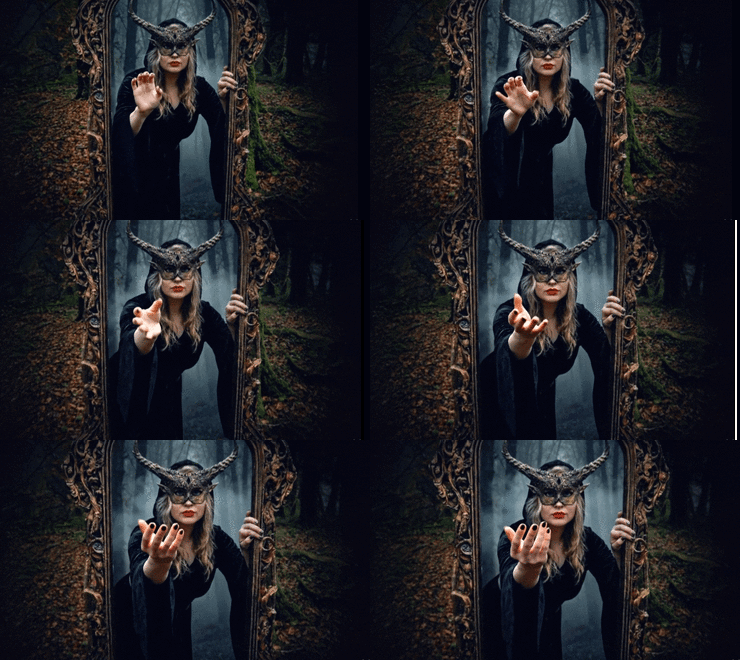
This was beautiful. I loved how the story transformed what first seemed like a curse into a relationship with the living world. The reveal that Rootvein wasn’t a disease but a symbiosis completely reframed everything that came before it.
“The roots really do remember.” That line hit me the hardest. It felt like the entire heart of the story.
Your worldbuilding is extraordinary, but what stays with me most is Xanthe finally realizing she was never broken only misunderstood. What a wonderful speculative fairytale. 🌿🖤
Thank you so much, Lauren. That means so much to hear. ❤️🤗
This is pretty good. The descriptions and characterizations build good depth, and you leave plenty of room for the reader to imagine around the corner. I also want to call out how well you balanced the stakes, which is something I think even well established writers get wrong kind of a lot. The world you describe has rules which we immediately pick up on: the imaginable bigotry or a small society, giant moths and extinct chickens, exotic traders with interesting wares. The fact that she goes out on her quest out of curiosity and not because of some emergency or immediate necessity lets the growth center on her entirely, without having to worry about responsibility to the plot.
Because this was a quiet task though, the reader never has to wait for it to start or get good. With higher stakes, the story would hinge on "Did she win?" But as it is, if you had stopped at the medical facility with her going home after learning about herself: good story. If she had pressed on, found the botanical lab alone, scooped up the flowers, and gone home: good story. If she meets Tiresias and he says they're all leaving forever, but now she knows they exists: still... good story. All of it together though means she gets a quest, faces challenges, expands her world, achieves her goal, and gives us a idea of what she'll do next.
While connecting with the audience. In 3500 words.
So, pretty good.
Have you read much by Terry Brooks? The way you blend genres and build the world out of personal perspective reminds me of his writing.
Thank you so much for reading and for your thoughtful comment. ❤️❤️
I appreciate this excerpt as an effective "primer" to a setting: who are the main characters, what's the world they inhabit, and where's the story going to be traveling next. I say effective because there's a schema that's building up that grounds us as readers into what you're speaking about, rather than nebulous names and vague descriptions. That can be challenging with fantasy since there's so much one wants to bring in all at once, but how can it be distilled down.
The first section, when she's back in the village among such curious flora and fauna, gave me the expectation that this is a new world unto itself. There's nothing wrong there, but there's an element of "wait and see" for what the author is introducing. Are these new animals going to be important? Are these names worth remembering? The reader picks through the information to build that schema and start understanding.
Where I really jumped was the revelation of "Chicago" as the hub, transitioning over from fantasy to post-apocalyptic. Now we've got the real-world scheme but meshing that with this new fantastical information, that's a hook. It was exciting to see where the old and new would shift and collide, and it carried us through to a conclusion. In particular, the exchange with the robot was executed in a way that delivered exposition, but wasn't a "lore dump" of info, but was instead a natural flowing conversation. That was my favorite part definitely
I'm also glad you didn't play coy with it too long. Like this line: "She spied an ancient wonder. She believed they had called them Fords. People had ridden in the Fords like some sort of metal deer. " It's clever for Xanthe's characterization but could get old quickly, but you didn't linger on that device.
As a last thought: in a third person narrative, I often wonder "who's the speaker" in a meta-sense. When there are lines like: "She believed him. She didn't care. She felt connected to everything." we are told an emotion, but who tells us? Do we need to take the statement as gospel since the narrator said so, or is the voice unreliable? A narrative built around that concept can enjoy that level of intrigue through bias, and the author can play around with that: what's said, what isn't, how something is said, etc. The story itself then becomes part of the world, closing the loop.
I definitely haven't mastered it yet myself, but it's something I'm considering more when writing. All the same, well done and thanks for sharing!
Thank you!
What a wonderful piece. Xanthe is such an engaging protagonist, and I loved watching her journey from feeling like an outsider to discovering she was never broken at all. The reveal of the Rootvein was beautifully done, and the blend of science, nature, and mythology made the world feel incredibly rich. Penelope completely stole my heart. This left me wanting to explore even more of this fascinating world. Wonderful storytelling.
Thank you so much, Monica! ❤️🤗
What an exquisite story!! This would make a wonderful YA series.
Great. I love post-apocalypse stories. The Rootveins make sense somehow, fungi are supposedly more animal than plant. I feel like I could live in that forest, and be half mushroom, fully in tune with it. I also love Penelope, and the AI medic that still functions 1000 years after programming. Logically, Xanthe would have to let more than one silk moth hatch, because she would need them to lay eggs for the future generation of silk worms. I'd like a sequel about the spinster/weaver Xanthe sells the silk to.
Good point! I think I meant it more that she kept one for personal companionship, but I should have phrased it better. 😆 Thank you for reading and engaging so thoughtful! I definitely want to return to this world and tell more stories.
The thing with Penelope is, she probably wouldn't have become so attached to Xanthe if there were more of her own kind. She would have stuck to them, like rats and ravens do. But maybe Penelope is special.
I think the Rootveined have a special affinity for insects, but I agree, I think the bond also has to do with relative scarcity of her own kind.
What a grand mysterious world.
Thank you so much!
Really loved how the story blended quiet wonder with hope, especially Xanthe's journey from seeing herself as cursed to realizing she was part of something much larger. The worldbuilding felt immersive, and the ending left me excited to see what she discovers next. Do you already have plans to explore more of the ancient ruins and the other Rootveined communities in future chapters?
Also I got an comm idea while reading if you don't mind can we connect in DMs? I can also share the idea with you there ^ ^
Thank you so much! I am hoping to return to this world at some point. And yes, feel free to DM!
Coming to know she's not weird or a mistake.
Nice.
Thank you!!
Not me adopting Penelope and the whole mushroom network halfway through, as if I had any say... I thought we were doing spooky ruins plus pretty dye, then the urgent-care machine went nope, you’re not broken, and I got very protective of Xanthe walking home with no hood. Tiny fluffy moth, weird root family, honey-yellow silk… fine, I’m in.
This warms my heart. I'm so glad that the world and characters spoke to you. ❤️🥰
Gorgeous story… I hope you write some more of it❤️
Thank you! I'm definitely thinking of writing a sequel!
Most excellent ☺️
Your lyrical prose pair with strong image of Xanthe anchored me into the story immediately. Stupendous work Lady Mythweaver.
Thank you so much for reading! ❤️🥰
Adventure time meets little mermaid. Loved this one, tons of opportunity for this universe! Here for it
Thank you!!!
Oh wow! This is so vivid and unique. It may be my favorite piece of yours yet, which is not a low bar. Magnificent. I hope you eventually return to this setting.
Thank you so much! I hope to!
I am reeling over the imagery! Nice work!
Thank you so much!
This was amazing. Thank you.
Thank you, Ray. ❤️🤗