


For full audio narration, please Press Play below. Created using ElevenLabs.
It had been nearly a thousand years since the End Times.
Xanthe had heard tales from her Gran that seemed too fantastical to be true. Of ancient cities and flying machines. Of metallic beings that could speak and of riches beyond measure.
All that was left now were the ruins. And Gran told her never to go there.
Their woodland cottage was peaceful. Quiet. Life was spent chopping Purplewood, gathering rootberries and glowfruit, and hunting three-eared hares and blue-tailed deer in season.
Xanthe made her own clothes by farming giant silkworms. Her neighbors thought her wasteful for letting one emerge each season.
Xanthe thought the silkmoths were worth far more than the silk they left behind.
She liked having a silkmoth companion. It was as large as a raven, and just as smart.
She gathered crimson dye from the beetroot trees and deep blue from the indigo laurels, weaving and dyeing more cloth than she could ever wear. The rest she carried to market.
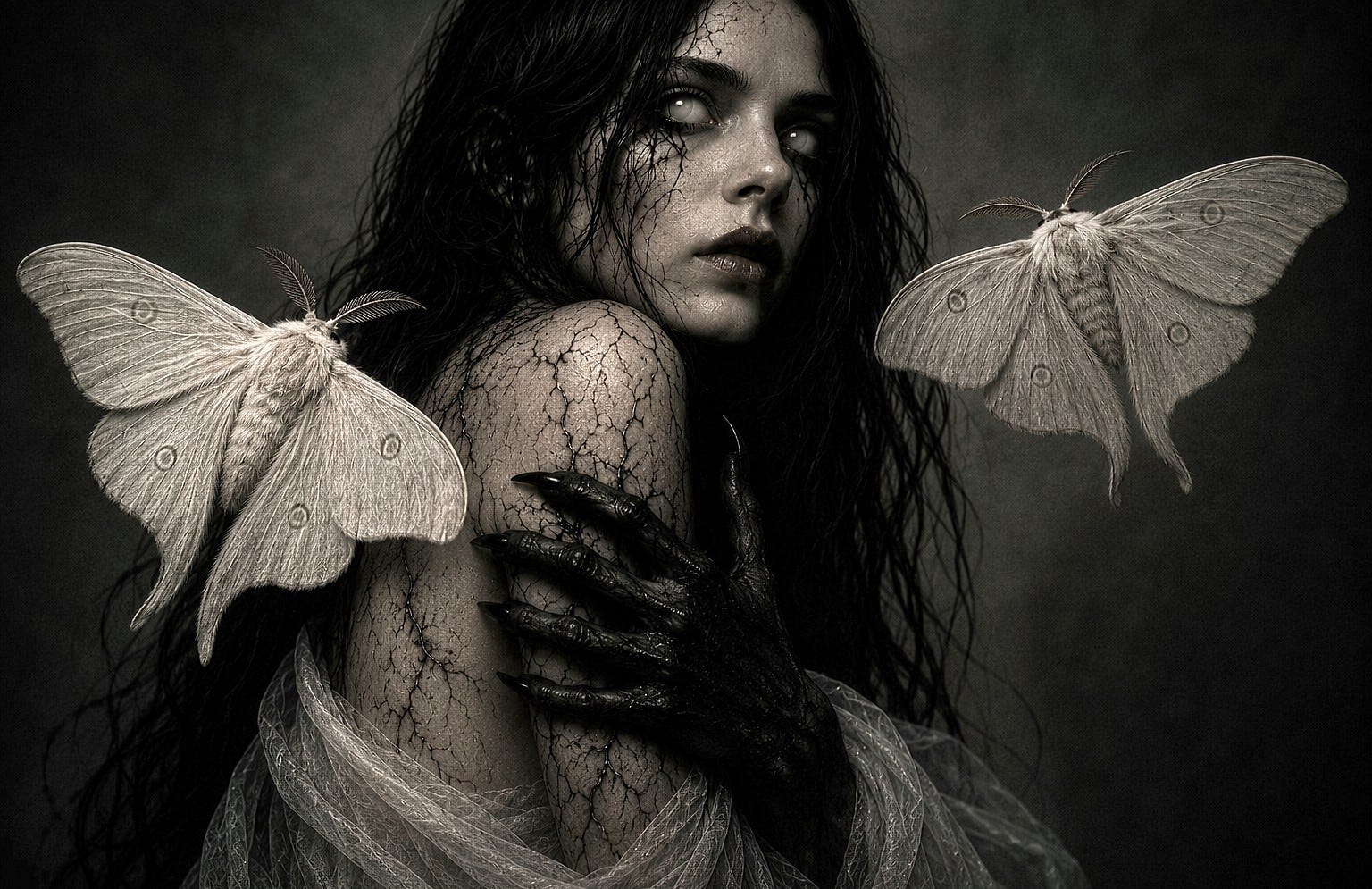
Xanthe had the Rootvein. She had been born with it. For all her sweetness and talent, people still feared her. Her eyes were pure white. Black veins branched beneath her pale skin like the roots of an ancient tree. Her hands were more like claws than fingers. But she was dextrous, and industrious.
No one knew what caused the Rootvein. Only that it had arrived with the End Times. And that the people with it were… different.
Xanthe supposed her difference was her skill in silkmoth husbandry. Or perhaps her weaving.
Gran always said, “Rootvein just means the forest chose you, sweetroot. Nothing to carry shame about. The roots remember their own.”
But Gran’s words didn't make the village stop staring. To Xanthe, it was an affliction. It made her strange. They called her changeling and cringed from her.
She hid it as best she could, but her white, pupil-less eyes gave her away no matter how she covered herself in silks.
That day, Xanthe wore a gown of raw white silk and a cloak of beetroot red. She hid her face within the hood. Her favorite silkmoth, whom she had named Penelope, rode demurely on her shoulder.
“Can't be bothered to stretch those wings, eh? Silly Penny.”
She stroked the silkmoth’s soft foreleg.
She bundled the folded bolts of silk beneath one arm and headed for market.
The villagers preferred that she leave her wares with Aeneas rather than linger in the market herself. Aeneas was one of the few people who seemed unbothered by her appearance and ran a general goods stall.
Her eye caught on some vibrant yellow fabric on display.
"Where did you get that?"
"A traveler," Aeneas said. "Passed through three days ago. Claimed there are yellow seedpods growing in the ruins. Make a dye unlike anything we've seen."
"Can you tell me where they went?"
"Already gone."
He hesitated.
"They were like you, Xanthe."
"Like me?"
"Rootveined.”
Xanthe's heart sank. She had missed her chance to speak with another Rootveined traveler, especially one who had ventured into the ruins.
They were rare. They seldom stayed long. Too many villages whispered about changelings.
She remembered the first Rootveined traveler she had ever met.
When she was small, he had shown her his pet dragonfly. It was a massive thing, nearly as large as young Xanthe herself. It buzzed and glimmered so very beautifully. She had never forgotten it.
That Rootvein had stayed overnight and in exchange had given them the most delectable mushrooms to eat.
He cooked them in blueboar tallow. The ancient texts said they tasted like chicken—a long extinct bird similar to our modern gilleyfowl.
Delighted with how they enjoyed the feast, the traveler disappeared into the forest for less than an hour. When he returned, he carried a basket overflowing with mushrooms no one else had ever found. A parting gift, he said. For the hospitality.
Xanthe salivated at the memory. She itched to know more. To know what the other Rootveins knew.
She'd never have considered it while Gran was alive. But last Dark Season, Gran had passed. Now it was Light Season again.
She left food for the silkworms, enough for a few weeks. She closed the cottage tightly. She packed a bag of spare silks in case she needed to barter.
And she set off for the ruins.
The old texts said that the ruins had once been a great metropolis called Chicago. That once millions of souls had lived within its borders in towers that scraped the sky.
Remnants of those towers still rose in the distance, crooked and crumbling from the rot of the End Times. Nature had reclaimed much of it. What had been rubble and concrete was now moss-eaten and shrub-filled.
Xanthe wondered what it must have been like, before the End. It was described as a place largely devoid of plant life. Just people kept like bees in a hive. Slick black paths weaving along the Great Lake.
There had been snow here, she’d heard. Before the End Times. Xanthe had never seen snow, but they said it was white and cold like the lake.
Penelope fluttered onto her shoulder.
“Coming with me? I don't know when we'll be back.”
Xanthe looked at her. Penelope simply preened her antennae in silence.
“Right then.”
She set off. She followed the curve of the Great Lake and aimed for the ancient towers that loomed on the skyline.
The closer she got, the rockier the ground became. Strange hunks of metal and oddly shaped stone had created mountains. Stubborn shrubbery still grew through the cracks, but things were desolate.
She spied an ancient wonder. She believed they had called them Fords. People had ridden in the Fords like some sort of metal deer. It was simply a shell of rusty orange now.
She went deeper. Even stranger Fords existed as she approached the towers that scratched the sky. Giant, long Fords that would have carried many, many people. Some of the Fords were even linked together on some sort of metal path.
Moss and vines had claimed many of the old metal giants, but what Xanthe noticed most was the sudden abundance of… mushrooms.
Penelope took wing and went to sit on one of the strange toadstools. It gave off a faint, pale greenish glow.
Beyond were massive fungi tall as trees. Long white stems rose skywards topped with caps that dripped down in black rivulets like congealed ink.
Xanthe felt a strange vibration. She felt it in her bones. And something like a song called to her.
But it wasn't music. It wasn't even sound. Just a frequency. A ripple. It urged her onwards.
The mountains of rubble became immense the further she went. The carcasses of what had been towers before the End. The fungi, too, grew taller. Stranger. They webbed between each other in haunting, lacelike drapes. Spores filled the air—at first slight, then thick. She pulled a spare silk out and wrapped it around her face to avoid breathing them in.
They likely explained the lack of people. She should be careful.
But still the fungi hummed sweetly, urging her towards the center of the ruins.
Then, her foot slipped. She hurtled downhill, her silks ripping and her legs dripping her strange, Rootvein blood.
She hated bleeding. It made her affliction more obvious.
Penelope fluttered to her side, looking as concerned as it is possible for a moth to look.
As her wounds quickly congealed she realized how much her black blood reminded her of those mushroom caps that dripped down like teardrops.
Odd.
She tried to stand.
And crumpled, sliding further down. At the base of the heap stood a building that still seemed remarkably intact. It had words written on it in the old language.
“URGENT CARE”
Well, that was certainly what she needed. Though she wasn't sure it could help her.
“Hello?” she called. “Anyone in here?”
She heard a whirring and a series of sharp electronic beeps.
"Distress vocalization detected."
"Emergency medical triage protocol initiated."
The whirring grew louder.
Hidden panels slid open somewhere within the walls.
A cool white light swept slowly over Xanthe from head to toe.
She shielded her eyes.
"Patient scan in progress."
The voice was calm. Genderless. Every syllable perfectly measured.
Penelope hissed softly and beat her wings.
"Do not be alarmed. Medical triage unit responding."
Xanthe's breath caught.
"A... spirit?"
"No response required."
The light lingered over the blood soaking through her torn leggings.
"External hemorrhage detected."
A pause.
"Hemostasis confirmed."
"No immediate intervention required."
Xanthe frowned.
"...What?"
"Blood coagulation complete."
The machine fell silent for several seconds.
Then:
"Identity confirmation."
"Homo sapiens."
Xanthe let out the breath she hadn't realized she'd been holding.
The light swept over her once more.
"Phenotypic analysis."
A series of quiet clicks echoed from somewhere inside the machine.
"Mycorrhizal symbiosis detected."
"Host integration stable."
"Post-collapse adaptive phenotype."
"Estimated phenotype origin: nine hundred seventy-eight years, plus or minus forty-two years."
"No evidence of pathological degeneration."
"Patient condition within expected physiological parameters."
"No treatment indicated."
“But… my leg. I fell.”
“Scanning.”
A narrow beam of white light passed over her ankle.
“Minor ligament strain detected.”
“No fracture identified.”
“Commencing splint application.”
A compartment opened beneath the wall.
Slender articulated arms unfolded with quiet precision.
Penelope darted into the air, wings beating furiously.
“Please remain still.”
Xanthe did precisely the opposite.
She stumbled backward.
The mechanical arms paused.
“Patient movement detected.”
“Procedure delayed.”
“They won't hurt you,” the machine said.
Xanthe stared.
“You... know what hurting is?”
“I am an emergency medical triage unit.”
“My purpose is to prevent it.”
The room fell silent except for the soft humming of servomotors.
Very slowly, Xanthe held out her injured leg.
The articulated arms wrapped it in a pale splint and bound it with a clean white bandage.
The machine withdrew.
“Treatment complete.”
“Patient prognosis excellent.”
Only then did it continue.
The white beam drifted past Xanthe's shoulder.
Penelope lifted one fuzzy foreleg as the light settled over her.
"Secondary organism detected."
"Scanning."
A brief pause.
"Lepidoptera."
"Species not found in archived database."
"Estimated divergence from historical lineage: nine hundred eighty-one years."
Another pause.
"Significant post-collapse adaptation observed."
"Body mass increased by approximately six hundred percent."
"Neural complexity exceeds historical baseline."
"Cognitive function consistent with highly intelligent corvid species."
"Wing morphology optimized for sustained powered flight."
"Silk production retained."
"Social imprinting behavior observed."
Another pause.
"Mutualistic association with primary patient."
Xanthe frowned.
"What?"
"The organism exhibits prolonged voluntary proximity to the patient."
"The organism demonstrates recognition of patient identity."
"The organism exhibits protective behavior."
"Behavior consistent with companion symbiosis."
Xanthe smiled.
"She's my friend."
The machine paused.
"Statement consistent with observed behavior."
Penelope fluttered back onto Xanthe's shoulder and neatly folded her great ivory wings.
"Secondary organism health: excellent."
"No treatment indicated.”
“Please state query.”
She swallowed.
"What... is the Rootvein?"
A brief pause.
"Rootvein."
Another pause.
"Colloquial designation not recognized."
“Why do I have black veins?”
More clicking.
"Closest match identified."
"Post-collapse adaptive mycorrhizal phenotype."
"The patient is healthy.”
“But what does that mean?”
A brief pause.
“In layman's terms…”
Another pause.
“The fungal organism that colonized Earth following the Collapse entered into a mutually beneficial relationship with some of the surviving human populations.”
“It is not a disease.”
“It is a symbiosis.”
Xanthe frowned.
“A... partnership?”
“Affirmative.”
"The fungal symbiont gains access to dispersed habitats, mineral transport, and reproductive distribution.”
“The human host receives enhanced immune function, accelerated wound healing, increased resistance to environmental toxins, and direct biochemical communication with mycorrhizal networks.”
Xanthe blinked.
“The... song. The mushrooms keep singing.”
“Correct.”
“The phenomenon you perceive as a song is electrochemical signaling transmitted through interconnected fungal networks.”
She looked back toward the towering mushrooms.
“They're... talking?”
“Affirmative.”
“They are exchanging chemical information.”
Xanthe strained to understand the song.
“The patient possesses the biological structures necessary to perceive portions of that communication.”
She slowly looked down at the black veins beneath her skin.
“So... I'm not cursed.”
“No evidence of pathology detected.”
“Then why do people fear us?”
The machine was silent for several seconds.
“Insufficient sociological data.”
Another pause.
“Medical records indicate that unfamiliar physiological adaptations frequently produce fear responses in baseline human populations.”
Xanthe smiled sadly.
“That sounds about right.”
Xanthe paused, taking in the new information.
“The spores? Will they harm me?”
“Negative.”
“Ambient spore concentration is within patient tolerance.”
“Your immune system recognizes the fungal organisms as symbiotic.”
Xanthe frowned.
“So they know me?”
“Affirmative.”
“The patient is recognized as part of the network.”
She looked toward the drifting clouds of pale spores.
“They're... alive.”
“Affirmative.”
“They are reproductive structures.”
“They also facilitate biochemical communication between connected fungal colonies.”
“So the whole forest…”
“The mycorrhizal network extends beneath approximately ninety-three percent of terrestrial ecosystems.”
Xanthe's eyes widened.
“The roots really do remember.”
The machine was silent.
“Statement consistent with observed ecological function.”
She smiled.
“Gran was right.”
“Clarification.”
“The patient exhibits no signs of fungal infection.”
“The patient is a stable symbiotic organism.”
“The distinction is clinically significant.”
Xanthe looked down at the black veins tracing her arms.
“For a thousand years…”
“Yes.”
“And people forgot.”
“Affirmative.”
“Cultural knowledge degradation following civilizational collapse exceeds ninety-eight percent.”
The humming outside suddenly sounded less eerie.
It sounded...
Familiar.
She removed the silk from her face.
“One further clarification.”
She looked up.
“The patient is not separate from nature.”
“The patient is an adaptation to it.”
Gooseflesh prickled across Xanthe’s arms. It was so much to take in.
“Right then. Thank you, kind machine spirit.”
She rose carefully, testing her newly bandaged leg.
“You don't happen to know where I can find a yellow pod that makes dye, do you?”
There was a brief pause.
“Query recognized.”
“Yellow pigmentation source identified.”
A beam of light projected onto the cracked floor, forming a map.
Several routes glowed faintly before one brightened.
“Destination: Chicago Botanical Research Conservatory.”
“Distance: 3.8 kilometers.”
“Facility status: Partial structural integrity.”
“Hydroponic systems: Operational.”
“Seed vault: Seventy-one percent viable.”
“Botanical specimens remain under automated cultivation.”
Xanthe stared at the glowing map.
“They're... still growing?”
“Affirmative.”
“Primary mission parameters include preservation of plant biodiversity.”
“The requested yellow dye is likely derived from Coreopsis tinctoria.”
She blinked.
“What did you just call it?”
“Tickseed.”
“Oh.”
She smiled.
“Yellow pod sounds easier.”
“Layman's terminology accepted.”
Another pause.
“Recommendation.”
“Patient should avoid Sublevel Three.”
“Hive density exceeds acceptable safety thresholds.”
Xanthe's smile faded.
“Hive?”
“Large arthropod colony.”
“Species identification unavailable.”
“Estimated body length: one point four meters.”
Penelope fluffed herself indignantly.
“Well.”
Xanthe adjusted her cloak and looked toward the ruins.
“I suppose we'd better meet the neighbors.”
She waved farewell to the machine, though it did nothing in response. She felt warm and cared for. The humming thrummed through her and she allowed the singing to lead her.
She was about halfway to the Botanical Research Conservatory when she saw something leap down from one of the linked Fords to stand before her.
“Who are you?” he asked, a tad suspiciously.
It was a Rootvein. Young and tall and strong. Wearing strange clothing she had never seen before.
“I'm Xanthe.”
His long, taloned hand closed around her forearm.
She no longer knew where she ended and he began.
The world vanished.
She saw streets she had never walked. Towers standing whole beneath a blue sky. Then the rubble and destruction. And finally the same streets drowned beneath forests of mushrooms, singing.
Countless Rootveined faces flashed before her. They were here. They were everywhere. She felt the vast fungal web stretching beneath the city, carrying memories instead of words. She knew his name before he spoke it.
Tiresias.
And then he let go.
Just as suddenly, the visions were gone.
“You may pass.”
He turned to walk away.
“Wait! Tiresias!”
He paused. “Yes?”
She didn't know what to say. She just knew she didn't want him to leave.
“I'm… umm. I'm trying to find the Chicago Botanical Research Conservatory. There are seeds there, that um… well that I would like to use as dyes. Could you… maybe… help me?”
His eyes flicked over her, assessing. And then moved to Penelope.
She fluttered close to him, landing on his arm.
“I like your moth,” he said.
“Thank you. Her name is Penelope.”
“I know.”
A pause.
“I will take you there, Xanthe of the Forest.”
Tiresias knew the easiest and most direct route. And it seemed, now, that Xanthe did too. She anticipated each step and turn he made.
Penelope fluttered along happily, apparently delighted to have a new friend.
A massive greenhouse of metal and glass lay in shambles before them. It was coated in fungi, like most everything.
The door had collapsed but they were able to climb in through a broken window.
Beyond the broken window lay a jungle untouched by time.
Great panes of fractured glass arched overhead like the ribs of some sleeping beast. Through the cracks, ancient trees thrust their branches into the conservatory, their roots winding around rusted catwalks and silent machines. Shafts of sunlight spilled through missing panes, catching drifting spores until they glittered.
Everywhere, things still grew.
Vines climbed ancient walls. Fruit trees bowed beneath impossible harvests. Orchids spilled from shattered planters. Water still trickled through narrow channels, clear as crystal, feeding beds of vegetables whose names had long ago passed out of memory.
Flowers of every imaginable color bloomed together without regard for season. Here and there, slender mechanical arms still glided quietly along rusted rails, pruning dead leaves, pollinating blossoms, and tending a garden whose gardeners had turned to dust nearly a thousand years before.
“They never stopped,” Xanthe breathed.
How mny more ancient wonders did the ruins possess?
She plucked a strange yellow fruit from a bunch on a nearby tree.
“You peel it.”
She peeled it as he suggested. Sweet, fragrant flesh gleamed beneath the thick yellow skin.
She took a bite.
It was magnificent.
“They used to call it a banana. It only grows in places like this.”
Xanthe could have spent forever there. There were so many wonders to take in.
A sudden loud clicking broke her reverie.
“We need to move quickly.”
Tiresias pointed.
A massive arthropod emerged from over a tree root thicker than Xanthe’s waist.
It had a shiny, black armored shell, ribbed and oval-shaped. Long antennae quivered. Many legs scuttled over the moss.
It hissed.
Penelope flew higher, uneasy.
"This way. We will grab your seeds. Swiftly, now. Quietly. Before the others come."
Xanthe gathered the seeds and tucked them in her bag. She took others too, that she thought might be worth trying.
Such treasures.
More clicking. More scuttling.
"Time to go."
Tiresias took her hand. Once again she felt that sense of knowing, but it was far less overwhelming this time. In her mind's eye, she saw the horde of creatures lurking out of sight.
They found a path to avoid them, and soon returned to the ruins proper.
Xanthe was panting.
"Thank you, Tiresias."
"Of course."
"I'm very glad I met you. I fear I must start home now."
"So soon?"
For a moment she almost thought he looked disappointed.
"I left food for the silkworms," she said. "But not forever."
Tiresias nodded.
"Sensible."
He glanced toward the ruined skyline, then back at her.
"There are others who would like to meet you."
Xanthe's fingers tightened around the strap of her bag.
"Other Rootveins?"
"Yes."
Penelope settled on Xanthe's shoulder and brushed her antennae against Xanthe's cheek.
Tiresias smiled faintly.
"And other moths."
Xanthe looked toward the road home, then down at the precious yellow seeds tucked safely in her bag. The weight of them felt different now than it had that morning—not just dye, not just barter, but proof. Something to carry back and show the village what the ruins had given her, even if they'd never understand what else she'd found there.
"I could come back," she said.
"You will know the way now."
She believed him. Already she could feel it. Faint, but unmistakable, the thread of song ran beneath her feet, patient and waiting.
The walk back to the village was far quicker and easier than the walk out had been.
She didn't bother to put up her hood. People stared.
She didn't care.
She knew what she was now. And she couldn't wait to learn more.
She felt connected to everything. The earth below her feet sang to her. As she wove her cloth that first night home, hands moving in the old familiar rhythm, she found herself humming along. She didn't notice for a long while that the song wasn't entirely her own.
A month later she carried her vibrant yellow silks to market, the cloth catching light like poured honey. The village looked on in awe and, for the first time, didn't flinch from the hands that had made it.
She saved some of the dye for a shirt. A token, for Tiresias, for when she returned.
She would take the silkworms with her this time. She needed time—to learn, to listen, to get to know the family she hadn't known she had.
Penelope, perched on her shoulder as they set off again, looked almost excited. Her wings fluttered and her fur rustled.
Almost as if, after all these years, she'd been waiting for this too.
If you have enjoyed my work here in the Labyrinth, please consider becoming a free or paid subscriber. If you prefer a one-time offering, you may “buy me a rose” and I would be most grateful. 🥀
This was beautiful. I loved how the story transformed what first seemed like a curse into a relationship with the living world. The reveal that Rootvein wasn’t a disease but a symbiosis completely reframed everything that came before it.
“The roots really do remember.” That line hit me the hardest. It felt like the entire heart of the story.
Your worldbuilding is extraordinary, but what stays with me most is Xanthe finally realizing she was never broken only misunderstood. What a wonderful speculative fairytale. 🌿🖤
This is pretty good. The descriptions and characterizations build good depth, and you leave plenty of room for the reader to imagine around the corner. I also want to call out how well you balanced the stakes, which is something I think even well established writers get wrong kind of a lot. The world you describe has rules which we immediately pick up on: the imaginable bigotry or a small society, giant moths and extinct chickens, exotic traders with interesting wares. The fact that she goes out on her quest out of curiosity and not because of some emergency or immediate necessity lets the growth center on her entirely, without having to worry about responsibility to the plot.
Because this was a quiet task though, the reader never has to wait for it to start or get good. With higher stakes, the story would hinge on "Did she win?" But as it is, if you had stopped at the medical facility with her going home after learning about herself: good story. If she had pressed on, found the botanical lab alone, scooped up the flowers, and gone home: good story. If she meets Tiresias and he says they're all leaving forever, but now she knows they exists: still... good story. All of it together though means she gets a quest, faces challenges, expands her world, achieves her goal, and gives us a idea of what she'll do next.
While connecting with the audience. In 3500 words.
So, pretty good.
Have you read much by Terry Brooks? The way you blend genres and build the world out of personal perspective reminds me of his writing.