
Libre Literati
Or: How I Became the Most Notable and Awarded Student Writer at Yale

Content Note: References to sexual assault, coercion, violence, murder, and drug use.
A gothic literary horror about secret societies, narrative power, and the price of greatness.
Despite my chignon, my hair whipped loose in the wind, strands sticking to my scarlet lipstick.
Convertibles, though fashionable, were terribly impractical. Especially for women. And this one was ancient. He hadn't even installed a car phone.
I reached into my handbag for an Hermès kerchief and tied it neatly beneath my chin.
What a sight we must have been.
Me in my sunglasses and silk scarf. Hugo beside me in his sleek European-cut suit, handsome in the clean-cut, retro way of old money.
Hugo drove a vintage Ferrari California Spyder the color of wet ink. It gleamed beneath the pines as we cut through upstate New York, autumn burning all around us. The trees were at their peak—a riot of crimson, gold, and dying amber beneath the pale October sky.
I knew of the Libre Literati, of course. I was considered a legacy. My grandfather had attended Yale before becoming a professor there, and had served as U.S. Poet Laureate.
When I started my first semester, I knew there was a possibility I would be invited to join.
Even so, my grandfather never spoke of Libre Literati. He respected the cloak and dagger of it all, which amused me to no end.
I supposed that was the nature of secret societies.
My letter had arrived a few nights ago.
Parchment and invisible ink. Embossed with a wax seal—black, laced with delicate gold. A black swan crossed by a quill and dagger. Beneath them, the initials L.L.
Hugo was already a member. Unsurprising, as he currently was the most well-respected and awarded student writer at Yale. And my unofficial paramour.
As I held the parchment to the flame, he leaned close and kissed the curve of my neck, the heat slowly awakening the hidden message from the page.
Invitation. Initiation. At an undisclosed location referred to only as the “Manor.”
And Hugo—smirking faintly beside me, hand stroking my knee—was taking me there.
“Nearly there.” He glanced at me hungrily, lifting my skirt higher up my thigh with a touch both possessive and familiar.
We turned up a long and winding drive. Hugo rang the buzzer. Iron gates creaked open to allow us entry.
The manor was enormous, though badly overgrown and visibly decaying. Ivy strangled the stone walls and several windows were broken and darkened with rot.
“Welcome to the Manor.” Hugo parked along the carriage house circle.
“Really?” My eyebrow quirked. “Hugo, this place is a dump.”
He tutted at me as if I were a disrespectful child.
“It is all part of the ambience, darling. Think of it like Satis House in Great Expectations. We're here to write, not to host dignitaries.”
He walked to the other side of the car and opened the door, taking my hand.
“Now, from here on out you must not call me Hugo. And I will not call you Katherine. In Libre Literati, my name is Quill.”
I laughed and rolled my eyes.
“Hugo, you can't be serious.”
His hand closed around my wrist with sudden force.
“Quill,” he growled.
I sulked.
“Sorry. Quill.”
“Better. And you…”
He studied me for a long moment, and then his lips quirked as though he had amused himself.
“Inkwell. Perfect for Quill. I'll call you Ink.”
“We're really all going to go by codenames all weekend?”
It seemed so ridiculous.
“Pen names, but yes. Or nom de plumes, if you prefer. Please try to take this seriously. You're about to enter the most exclusive writers retreat in existence. A bit of gravitas would serve you well, Ink.”
I sulked again, then made my best attempt at gravitas.
“Fine, Quill,” I acquiesced. He nodded, grabbing our suitcases from the trunk and rolling them towards the dilapidated manor.
He rapped on the front door seven times, in a unique percussion. A similar knock followed from within. He responded with what seemed to be a password.
“Cognoscenti.”
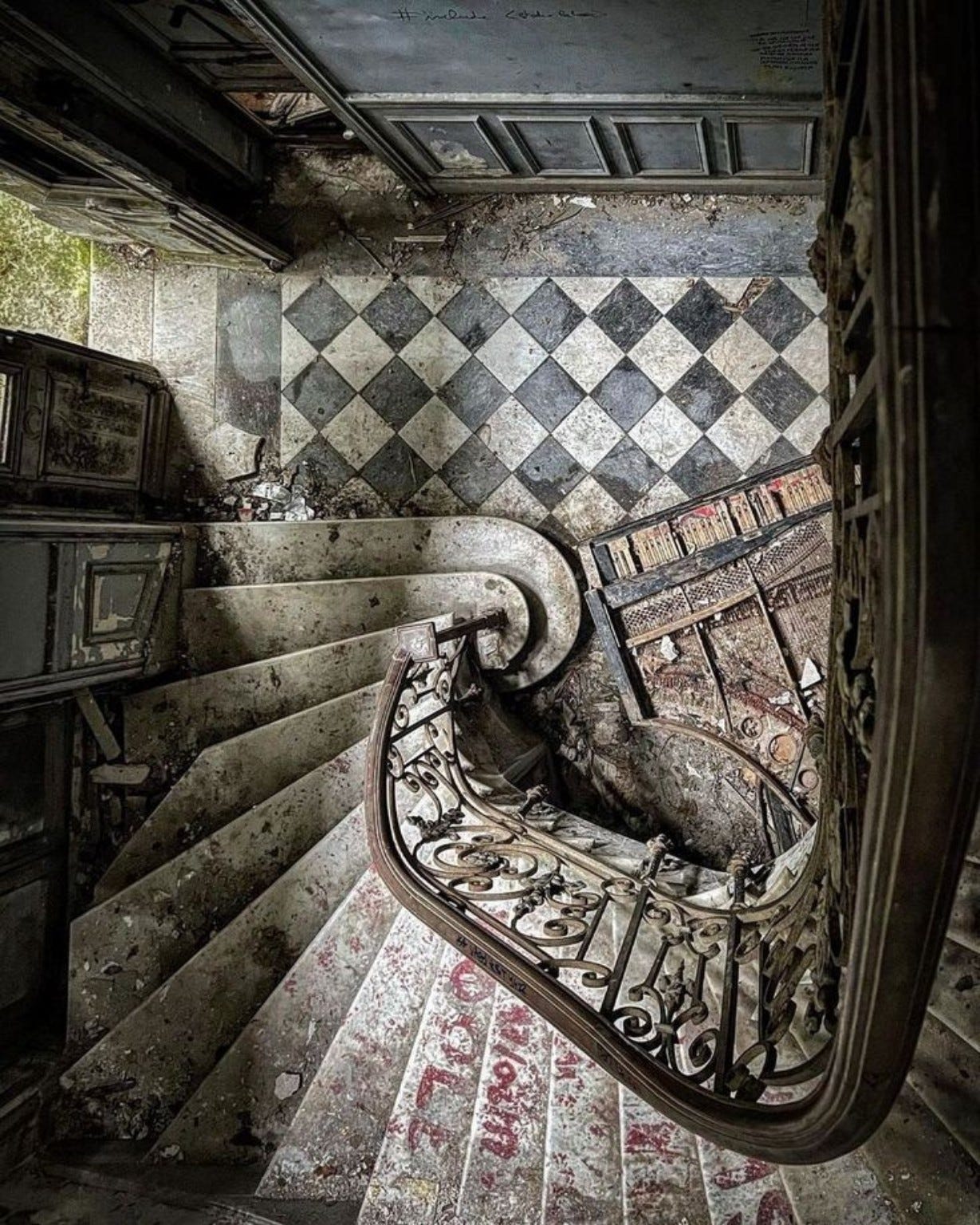
The door opened on a foyer with black and white tiled flooring like a giant chess board. Fallen plaster lay in chunks, dusting the room with a faint white film.
I briefly worried about asbestos exposure.
A stairwell loomed—damaged. Dangerous. The scent of mildew and must was overwhelming.
No one was there.
I opened my mouth to once again complain to Hugo about the state of the place… then closed it.
He walked confidently forward and I toddled behind, concerned the house might collapse on top of me.
When the next door opened, I was shocked to find a perfectly restored study. Bookshelves lined one wall. On one chaise lounge, a young man—lean and well-groomed in the way that suggested a close relationship to his mirror—reclined lazily, reading a book. As we entered, he sat up.
“Ah! Quill, my boy! And who do we have here?”
“Inkwell.”
Hugo presented me formally.
I gave a little curtsy, as the young man raised an eyebrow suggestively.
“I see. Atta boy, Quill.”
He winked.
I cringed internally.
I should have been expecting a boys club, really.
“And you are?”
It came out a bit sharper than I intended.
“Dust Jacket, Milady Inkwell.”
He bowed with a flourish.
“Where are the others?” Hugo—I mean, Quill, asked.
“Oh, around and about.” He gestured vaguely in the air. “Some in the library. Some in their rooms. Some doubtless cavorting about the grounds. You know how they are.”
“Herding cats.” They said at the same time, and chortled.
“And Father Grimoire?”
“Hasn't arrived yet. You know he likes to make an entrance. So go have fun, you rascals. Show Ink the Manor. Show her your room…”
Again the waggling eyebrows. Ugh.
“...because you know when he arrives it's all business.”
“Right-o, mate.” Quill exchanged some elaborate fraternal handshake with Dust Jacket—my God, that name was absurd—and led me onward into the next room.
We wandered through labyrinthine halls in various stages of disrepair before arriving at a pristine library. Dark walnut paneling gave the room a cavernous quality, so much so that it felt a bit like literary spelunking.
The room was lit only by candlelight. Figures hunched over long tables whispered amongst themselves while shadows flickered across stacks of leather-bound books.
The scent of ancient pages and dust filled my nostrils. Our footsteps echoed as though in a cathedral. Upon hearing our entry, the chattering stopped.
The figures turned and looked at us.
Some wore standard Ivy League casual—polo shirts, tennis skirts, cable knits draped over shoulders—while others looked almost funereal in dark suits and cocktail dresses.
“Greetings, all,” Quill grabbed me by the elbow and pulled me up before him. “May I introduce Inkwell—legacy initiate.”
And suddenly, it was as though all formality broke. Warm smiles replaced somber faces and I was welcomed with open arms.
Blot, Cipher, and Vellum seemed to move as a unit. Fresh-faced college boys who each tried to sound more intelligent than the last.
Lexicon—Lexi, she insisted almost immediately—pulled me aside as though starved for female company. She was a poet, and a damn good one, if she was to be believed.
I suspected she was.
Binder was a bit older, perhaps a professor or a grad student. His eyes lingered on me a bit too long.
Beside him, a woman with greying hair introduced herself as Script.
“I will take the initiate off your hands, Quill,” she said, with an authority I didn't quite understand.
Quill looked like he was about to argue, but decided against it. I felt his warm hand leave my arm and a chill shot through me.
“This way, Inkwell dear. A few more introductions are in order.”
I allowed her to lead me from the room.
More hallways. More decay.
We walked in silence, climbing a staircase that seemed in at least somewhat less likely to kill us than the one in the front hall. She opened the door to a bedroom.
It was beautiful.
A four poster bed with burgundy velvet linens. Brass lamps. Trompe l'oeil paintings of nymphs and satyrs frolicking amidst a Dionysian feast.
On the bed lay a long black gown—like a graduation gown. But velvet. Hooded. Beside it sat a large golden brooch, embossed with the same seal as my letter—black swan, quill, dagger.
“These are for you, child.” Script ran her fingers reverently over the velvet robe and golden pin.
“And this room is your own. A haven. A retreat. Don't let that boy keep you from it if you are in need of it.”
Her hand caressed my cheek, softly.
“Your grandfather is a good man, and one of the greatest literary talents of his age,” she said softly. “I am certain you will follow in his footsteps.”
I blushed, and gave her a small smile.
“What… what should I expect? From initiation?”
“Oh, some secrets are not mine to tell, love. But I will say this—observe. Ask questions. You have a sharp mind, child. Libre Literati will require you to use it. Knowledge is power. Secrets are currency. The dagger we wield is truth. And remember—you are here to write.”
I nodded, as if I understood.
I did not.
“Now rest, child. Get settled in. The Feast of Plautus is nearly upon us. Dress for dinner, and wear your robe and pin. Oh—I nearly forgot.”
She moved suddenly to the wardrobe, pulling the door open and revealing a small treasure trove of masquerade masks.
“Do be sure to come masked. Someone will be up to fetch you at eight.”
And then she was gone.
I was dressed and ready before eight. I chose my mask—an owl in burnished gold, the carved feathers so detailed you could almost believe they were downy soft.
I reapplied my scarlet lipstick, glancing into the mirror. I looked a bit haunted, but elegant. It would have to do.
I sat down at my desk and pulled out my microcassette recorder. I didn't have enough time to write down the events of the day, but I often dictated notes for my writings.
A knock at the door.
I tucked the recorder in my pocket. Probably best to not be seen with it given the secretive nature of it all.
“Come in.”
My grandfather stood there, in a black hooded gown much like my own.
“Ahh, Katherine.” He embraced me, using my true name. “Look at you. I couldn't be prouder.”
I hugged him tight. His hand caught the mask that dangled from my fingers.
“Good choice.”
He showed me his own mask. A horned owl, feathers rising like a crown. Antlers jutted from behind the feathers. It looked ancient. Ceremonial. Pagan.
“From here on out, you shall be Initiate Inkwell and I shall be Father Grimoire. But I just needed to see you.” He kissed my cheek and placed the ornate mask over his face.
“Now, Initiate. I must explain something to you of dire consequence. The Feast of Plautus is a night of cleverness. Of getting to know your fellows. But it is also a night with teeth.
For you to rise, one must fall. Do you understand me?”
He paused.
I must have looked confused, because he went on.
“Words have power, Inkwell. Libre Literati are shadowed, yes. But we are Kingmakers. Narrative is the knife. It decides who remains—who matters to history. This is how it has always been. How nations rise and fall.”
I nodded.
“Right then, Inkwell. I must prepare for the Feast. Come down to the Great Hall when you are ready. Good luck, dear.”
He closed the door behind him.
I placed the mask over my face.
The Great Hall was enormous, and reminded me of rooms I'd seen in old Tudor palaces. Two long tables draped in wine-colored cloth were covered in a veritable cornucopia of fresh fruit and roasted meats and freshly baked breads.
Tapestries bedecked the walls—old and worn with time, their scenes still recognizable.
Bacchanalia.
It seemed to be a bit of a recurring theme.
Society members milled about, and I took in their masks. Peacocks, foxes, ravens… and some like woodland sprites or ancient devils.
One such demon approached me, smiling.
Hugo—no, Quill.
“Hello, darling. Clandestine attire suits you.”
“Why thank you, Master Quill.”
“Shall we feast, then?” He offered his arm, like a proper suitor.
I took it.
There were many more people in the room than those I had met before.
Wine flowed freely from a fountain in the corner. Hugo handed me a glass and raised his own in a toast.
“To the literati.”
The glasses clinked.
There were no plates, I noticed. People simply plucked grapes and figs and ate them with their bare hands. I was handed strips of meat—exotic ones. Elk, pheasant, ostrich, and more. The longer the wine flowed the less concerned with cleanliness and propriety everyone seemed to be.
And then he arrived.
Father Grimoire.
I looked down at my greasy, berry-stained fingers and felt a twinge of embarrassment.
The room fell silent.
Father Grimoire addressed the assembly in a voice that sounded less like my grandfather and more like some ancient druidic shaman.
“Good evening, my children. I do hope the feast is to your liking. Tonight, we shall initiate a new member among us. Come forward, Inkwell.”
I stepped forward, a bit awkwardly. Everyone was staring at me.
He produced a crystal vial, with a strange clear bluish liquid inside.
“This is Lethe. Every year on the Feast of Plautus, the members of Libre Literati drink of this miracle. To forget. To remember. To dream away the rot and envision a new world. We feast, we frolic, we share our deepest held beliefs.
And then—we write. And the world quakes and plates shift.”
He removed the stopper and handed me the small bottle.
“Drink, my child. And become one of us.”
I drank deeply. It tasted like citrus and the seashore. Like memories long forgotten.
Father Grimoire took the vial from my hand and beamed at me, raising his hands above his head as he bellowed.
“Welcome, Sister Inkwell! May your tongue be sharp, and your pen be true.”
The assembly echoed, “May your tongue be sharp, and your pen be true.”
I made my way back to the feasting tables, feeling a bit giddy and light-headed. What was in that stuff, anyway?
As I wondered, the assembly organized themselves neatly into procession. Each approached Father Grimoire and was handed a vial of Lethe to drink. Each was granted the same blessing.
I couldn't help but think it seemed an awful lot like a Roman Catholic communion line.
Before long, everyone had imbibed. Including Father Grimoire himself.
Then music began to play from a record player somewhere unseen. It had a driving, folkish beat, layered with haunting strings and pan flute.
Father Grimoire descended on the feast, ripping off a leg of pheasant and eating it, juice dribbling down his mouth.
Everything felt vaguely dreamlike. Fuzzy.
Free.
Wine continued to flow in abundance.
Soon, many people had removed their ceremonial robes, citing the heat.
Others joined. Before long, the entire room was in various states of undress.
But still masked. Always masked.
Father Grimoire sat beside me. He did not seem like my grandfather, in his mask and boxers and suspender-socks.
“Did you know? You nearly had a sister.”
“What?” I asked, genuinely baffled.
“Your mother had an abortion!”
He laughed and toddled off. My stomach sank, but then the Lethe-induced levity washed it away.
I sat down near the trio. Blot, Cipher, and Vellum, all nearly nude. Dust Jacket was off to the side, looking bored. Lexi stood anxiously in the corner.
“What's the worst thing you ever did?” Blot asked me.
I thought on it.
And then the truth slipped out, unbidden.
“In 10th grade I stole $100 from Alice Wingate and blamed it on Maria Gutierrez. She got expelled. I didn't even need the money.”
Everyone nodded.
“That's a good one,” Blot said, not unkindly.
They took turns, one by one, sharing brutal truths.
Lexi had crashed her parents car into the lake and said it was stolen. Vellum had taken advantage of more drunk girls than he could count or remember, and then called them sluts after, destroying their reputations.
When pressed, he admitted he picked ones with pristine reputations on purpose. It made him feel powerful, to soil them.
Through the haze of the Lethe, I felt a small moral tug. That felt wrong, didn't it?
I suppose everyone was doing wrong. Did it really matter?
And then it hit me, like a jolt from a socket.
This was what they had meant.
Knowledge is power. Secrets are currency.
And the Lethe was setting every secret in the room loose.
Quill sat down beside me, stroking my bare leg amorously.
“What's going on over here then?” He asked brightly, though his words slurred slightly.
“We're sharing the worst thing we ever did.”
Lexi scuttled over to sit on the other side of me.
“Care to join?”
Something seemed to flash behind Quill’s eyes, then his pupils dilated and any worry he had felt seemed to melt away.
“Remember that French exchange student that went missing in New Haven last spring?”
“Of course, it was all over the news,” Cipher said. “Cerise, wasn't it? Pretty little thing.”
“She's not missing. I know exactly where she is.”
I went still. I remembered seeing the news about Cerise. Petite, beautiful, short dark hair. Studying Art History at Yale on exchange. Went missing before I started my first semester.
I subtly felt in my pocket and hit the record button.
Just in case.
There was a silence that stretched a bit too long, before Lexi gave a little laugh.
“Well where is she then? Where have you hidden her?”
He gave a knowing smirk.
“She was good fun, you know. Cute accent. Smart enough. Sexy as all hell. Liked to play little games, you know?”
He looked around at the men in the group, seeking understanding. They nodded and he continued.
“Liked it rough. Liked to say no. I still remember her little squeals. Pleading is so much hotter in French.”
Everyone took this in, glassy-eyed and silent.
“She didn't understand her place. I opened doors for her. She didn't belong, but I made it so she was accepted. The little bitch owed me.
And then when she said she was going to go to the police… she used the word coercion. Coercion? I've never needed to coerce anyone in my life. Little liar.
So we played another little game. We played until the pleading stopped.”
“Okay sure, but where is she?” Lexi asked what we all wanted to know.
“Oh, there's a lovely little tree over at West Rock Ridge. Twisty, and lithe. Like a ballet dancer. It reminded me of her. So I had her put there to rest. I think she would appreciate it, the way I thought of her even at the end.”
“I’m sure she would,” Dust Jacket said sincerely.
The sun rose and we all stumbled back to our rooms. I found mine and locked the door behind me. Then I fell into blissful slumber.
My dreams were vivid and strange. Nymphs and satyrs dancing along the River Lethe.
When I awoke it was late morning.
I gathered myself, tucking my hair into a ponytail and slipping into an argyle sweater and chinos. Given it would be a day of writing, I donned my wireframe spectacles.
What a night that had been. Everything felt a bit fuzzy. I felt there was something I was forgetting.
We all gathered in the Great Hall at lunchtime, everyone looking a bit worse for wear. But the Hall itself was pristine. Like we had never feasted. Like we had never drank the Lethe.
My grandfather was back in his standard uniform of tweed suit and tortoiseshell glasses, his grey hair neat and tidy. Professorial, as always. It was hard to believe the version of him from last night was real.
Next to him sat Script. They were huddled and speaking quietly.
Then he rose and addressed the room.
"Good afternoon, everyone. Today we begin our Writer's Retreat. You will have three days to create to the very best of your ability. This is a competition. The piece that is the most earth-shattering will win this year's Black Swan Award—the highest honor we can bestow."
A pause. Then—
“Now, go forth, my children. May your tongue be sharp, and your pen be true.”
From there, it was a blur. Headaches and hanovers. Writing workshops, critiques of our older works, chatter about our favorite authors (bonus points if they were particularly obscure and esoteric) and lots of time in solitude spent writing.
I agonized over what to write. What would be sufficiently earth-shattering—not just to win, but to earn my place. To earn what I was owed.
One line kept ringing in my ears.
For you to rise, one must fall.
That evening, I found the recorder in the pocket of my robe.
For a moment, I only stared at it.
Then I pressed play.
Hugo.
It hadn't been a dream.
I considered, briefly, whether it was it right to use Cerise’s story this way.
Then, I sat down and began to write.
The piece was finished.
The most compelling one I had ever written.
La Fille sous l'Arbre. The Girl Under the Tree.
I toyed with the dagger-shaped letter opener, chipping small curls of wood from the desk. Outside, the autumn trees stood burning at their peak—crimson, gold, dying amber.
They would be here for Hugo soon.
I had called the authorities. I gave them the location. I gave them everything they needed.
I kept the recording for the reading.
I won the Black Swan Award.
As my piece was read aloud, Hugo stood and walked quietly from the room. No one stopped him. I am not sure anyone tried.
They found him before nightfall. Swinging from a tree on the grounds—twisty, and lithe. The authorities said it was a terrible thing.
He didn't bother with a note. Everyone would know everything soon enough.
I gave them the recording. Open and shut case.
Cerise was found and brought home to her family in Lyon.
My grandfather said nothing when he embraced me. His eyes said everything.
Pride.
I became the most notable and awarded student writer at Yale.
One had to fall so another could rise.
That was the way of things. The way it had always been.
The way it would always be.
Absolutely chilling and immersive. Incredible atmosphere and tension throughout!
enjoyed truth emerging through ritual intoxication instead of rational process. The Dionysian themes and the way the story turned confession into power were interesting. Your prose flows very naturally.