


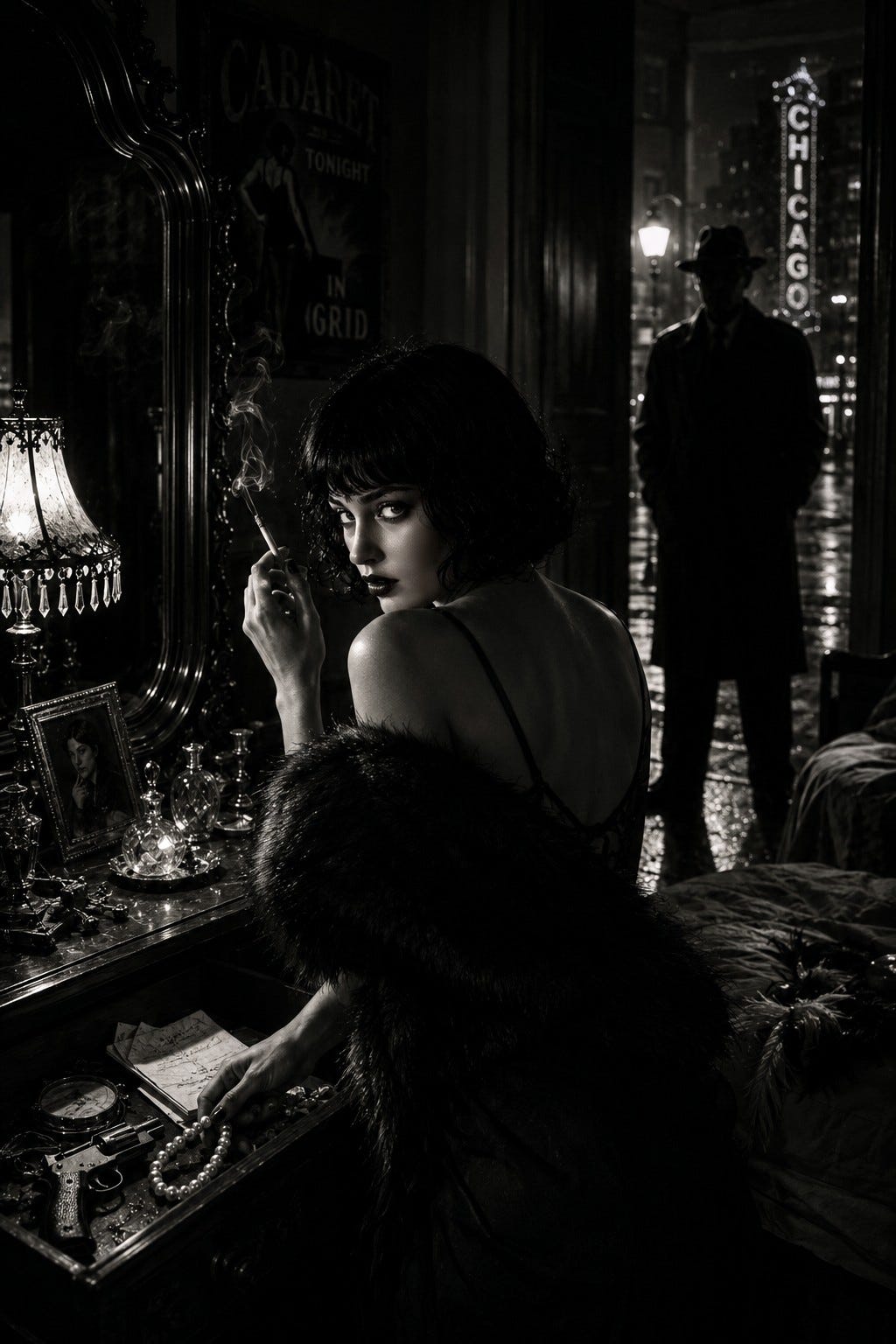
Chicago, October 1938
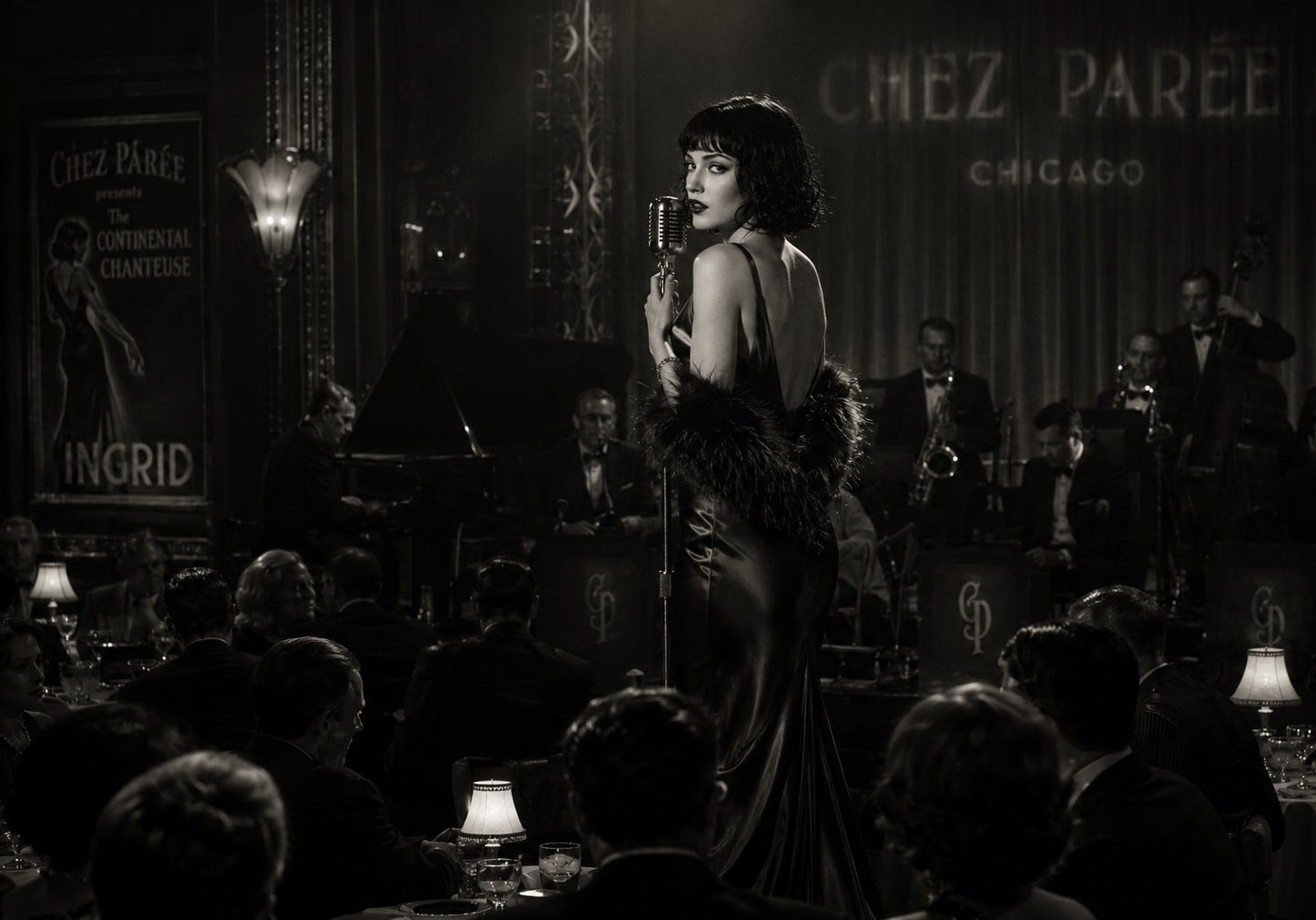
Cigarette smoke hung over the Chez Paree like a thick, heady fog. Crystal glittered. Champagne fizzed. The orchestra swelled.
Politicians, industrialists, celebrities, and socialites mingled beneath the chandeliers, reveling in prosperity that felt hard-won after the long, lean years of the Depression.
Men in dark suits manned the entrances and exits. The Outfit ran this establishment, and they never let anyone forget who was really in charge.
Chorus girls swept onto the stage in feathers and sequins, kicking in perfect unison. They called them The Adorables. The prettiest girls in Chicago.
But people weren't there for them. Not tonight.
The dancers parted.
A single spotlight found the woman standing alone beside the microphone.
She wore a black satin gown cut low across the back, skimming her figure like running water.
Long opera gloves reached her elbows, and a silver fox stole rested carelessly on her shoulders.
A sleek, dark bob framed a face that might have belonged to Berlin, Vienna, Prague—but nowhere anyone could name with certainty.
Her beauty was exquisite.
Foreign.
Dangerous.
The marquees around the city simply called her the Continental Chanteuse.
She was a beautiful mystery.
And mystery was Chicago's favorite indulgence.
A muted trumpet heralded her entrance.
She leaned toward the microphone.
The first notes of Smoke Gets in Your Eyes drifted beneath the chandeliers.
Her low contralto filled the club.
Every conversation stopped.
They stared, enraptured.
Tonight, she sang in English.
Sometimes in German. Sometimes in French.
Sometimes, on gloomy evenings, she sang in a language no one understood.
Yet somehow, even without understanding a word, they still wept.
Her voice was melancholy velvet draped over a revolver.
The final note lingered beneath the chandeliers.
Silence.
Then the room erupted into applause.
Flowers landed at her feet. Men rose to applaud. Someone called for an encore.
Ingrid smiled, bowed once, and disappeared behind the velvet curtain.
Her dressing room held a wardrobe worthy of a Broadway star. A rich collection of satin gowns, feathered wraps, jewel-toned silk…
...and, hanging apart from the rest, two impeccably tailored tuxedos.
Chicago never expected a woman to wear them.
Which was precisely why she did.
Red roses sat on her vanity.
They were beginning to wilt.
She couldn't remember who had sent them.
There was a sharp rap at the door.
“Ingrid. Tony wants to see you.”
“I'll be right there,” she said, in an accent no one could quite put their finger on.
She freshened her lipstick, checked a stray curl in the mirror, and went to see the boss.
The best table in the house had sat empty all night. Until Tony Cicero arrived.
He sat in a fine, dark blue suit, puffing on a cigar. People vied for his attention, but always respectfully.
Champagne flowed.
Yet the chair at his right remained empty.
Waiting for Ingrid.
She sat down.
“Good evening, Tony.”
“Good evening, my beautiful little songbird. Lovely performance. I heard the end as I arrived.”
“Ach, Liebling…. such flattery. You'll make me impossible to live with.”
A waiter handed her a glass of champagne without anyone asking.
Tony nodded toward a man in a brown fedora.
"Never seen him before."
Ingrid followed his gaze.
The man was staring at her intently. She shifted uneasily.
"Neither have I."
"Go introduce yourself."
"What do you want from him?"
"Find out whether he's here for the music.”
She nodded, and drifted over to where the man stood, stopping briefly along the way to catch up with regulars.
She laughed at a senator's joke.
Kissed a socialite on the cheek.
Thanked an elderly couple for the roses they'd sent last month.
She never looked toward the man in the fedora.
She never had to.
She could feel him watching.
“You're staring,” she said with a smile. “I don't believe we've met.”
“No, we haven't.”
His voice had a clipped, nasal Chicago accent.
“Well, I hope I'm living up to your expectations.”
“That remains to be seen.”
She cocked her head at that.
“Oh?”
“Indeed.”
“You're a connoisseur, then?”
“Something like that.
Tell me… is Ingrid your real name?”
Her smile faltered.
“Of course. Ingrid Weiss.”
A faint smile touched his lips.
He studied her for a long moment.
“No. I don't think it is.”
“Excuse me?”
"The funny thing is… there's no record of an Ingrid Weiss. I looked for her. She seems to have appeared out of thin air."
“Perhaps I'm a phantom.”
“Perhaps you are. Thing is, phantoms have pasts. They belong to places. To people.”
“I belong to no one.”
"You speak German beautifully."
"Thank you."
"Almost too beautifully."
For the first time that evening, she hesitated.
Then she smiled.
"Good day to you."
She turned before he could say another word.
That evening, Ingrid walked home. Alone, as always. She had on a heavy dark coat and a kerchief. She preferred to blend in on the streets.
A few times she glanced back, convinced someone was watching her. But there was no one.
That man had unsettled her. Perhaps she was imagining things.
She arrived back at the boarding house late, but Mama Ethel was still up. The smell of chicken paprikash filled the hall.
A violin played a melancholy song, and a cacophony of voices in many languages—Polish, German, Slovak, even Turkish—filled the air. Someone laughed from the kitchen. A pot lid clattered. The whole house smelled of paprika, onions, and fresh bread.
She took off her coat just as Mama Ethel walked out of the kitchen, wielding a wooden spoon like a baton. She was a sturdy Hungarian woman, and ran the house as though everyone in it was her child.
“Oh Cica, look at you! You are far too thin. You smoke too much. And you look so tired. Come in and let Mama Ethel get you a plate of paprikash.”
“No, Mama. Thank you.”
“Silly chicken. Sit. Eat.”
She did as she was bid. There was no arguing with Mama Ethel.
Once the food was set in front of her, Ingrid dug in with abandon. It was so good. Warm, and comforting.
"Mustafa brought a treat this afternoon," Mama Ethel said, setting another spoonful of paprikash on Ingrid's plate. "He brought figs. Nice boy. When supper is finished you can have fig and honey.”
Mama Ethel set the plate of figs on the table, grabbing one for herself with a smile.
Ingrid never ate at the Chez Paree. She was always performing. Always working.
At Mama Ethel's boarding house, she could finally stop performing.
In the corner she saw Fritz kneeling at the oven. He was a middle-aged German machinist with the mind of a scholar. Mama Ethel caught her watching.
“He's fixing it.”
“Fritz always knows how to fix everything.”
“And that is why Nándor stays for free.”
“Why do you call him that?”
“Because Ferdinand is too German, and Fritz is even worse. My kincsem here is my Nándor. He saves me from ruin.”
“I can hear you, Liebchen.”
“Danke dir, mein Lieber.” She winked and blew him a kiss.
When her stomach was full to bursting, Ingrid excused herself and went to her room.
She sat before her vanity and began removing what remained of the Continental Chanteuse: lipstick, powder, chandelier earrings.
She slid open the top drawer to return the earrings.
Her fingers brushed a strand of pearls.
The only thing she’d brought with her from Europe.
Her mother's.
She closed her hand around them, holding them for a long moment, as though warmth alone might bridge an ocean.
Beside the pearls rested a Colt pocket pistol.
She had bought it three days after stepping off the train in Chicago.
She donned her nightgown and climbed into bed. She slept fitfully that night.
The next day arrived too soon. She made her way back to Chez Paree, incognito as always. Once she arrived in her dressing room, the mask went on.
That evening she chose an emerald silk gown with a peacock feather headpiece. Black opera gloves and chandelier earrings with green Swarovski crystals completed the look.
As she approached the vanity to put on her face for the night, her heart stopped.
Edelweiss.
A small bundle of the white Alpine flowers lay bound with a white lace ribbon beside her powders.
No name. No card.
Only one person gave her edelweiss.
But it couldn't be. Perhaps it was just someone who believed her to be German sending flowers…
She tried to steady her trembling hands before continuing her nightly routine.
She dabbed on crimson lipstick and pinched her cheeks.
Showtime.
She sang Parlez-moi d'amour, Ich bin von Kopf bis Fuß auf Liebe eingestellt, and finally These Foolish Things.
The audience adored her.
Between sets she searched every table for the man in the brown fedora.
He never appeared.
She walked home that night as usual. As always, Mama Ethel made sure she ate something before she went to bed.
She had just put on her nightgown when she heard a knock at the door.
“I'm okay, Mama Ethel. I promise! I had plenty of goulash.”
"Cica," Mama Ethel called through the door.
"There is a gentleman here to see you."
Ingrid frowned.
"He says... he's your husband."
Ingrid froze.
Her whole body trembled.
Then, with numb legs, she opened the door and followed Mama Ethel downstairs.
When they arrived, Mama Ethel looked uncertain.
"Would you like me to stay, Cica?"
Ingrid lied.
"No, Mama. Everything is all right.”
Mama Ethel shut the door behind her.
A man stood in the parlor. His jaw was chiseled and his mouth was a firm, thin line. Perpetually disappointed. Mostly in her.
“Good evening, Ilonka.”
She shivered.
"János.”
“You seem surprised to see me, szerelmem. I hear you call yourself Ingrid now.”
“You need to leave, János. I'm not that person anymore."
He studied her for a moment.
"Of course you are."
A faint smile. He stepped forward, cupping her chin and dragging her gaze up to meet his.
"You're Mrs. Ilona Kovács."
A beat.
"You've simply forgotten.”
She started to turn away from him, but he gripped her arm. His fingers bit into her flesh.
She winced.
“It is time to go home to Budapest. You have had your holiday. And my patience has run out.”
She tore herself away from him.
“I'm not going anywhere with you,” she spat.
“We will see about that.”
He looked down at her coolly.
“You're still my legal wedded wife. You belong to me. And I've invested a fair amount of time and money tracking you down. Don't make this harder on yourself than it needs to be.”
She wanted to run. Instead, she straightened her spine and asked:
“How did you find me?”
“I hired a private investigator. Wonderful chap. Very thorough. I believe you've met.”
The man in the brown fedora.
He must have followed her here.
Ingrid turned and opened the door.
“Mama Ethel, János was just leaving. I am going back to my room.”
The men had gathered not far from the parlor, suspicion on their faces.
Mama Ethel nodded.
For a moment János looked like he would argue, but decided against it.
“I will be back, Ilonka. Think about what I've said.”
And with that he was gone.
Mama Ethel looked from Ingrid to the closing door.
Then she said, “You know, Cica, I always did think you sounded Hungarian.”
Ingrid went to sit in the kitchen. Mama Ethel followed without a word.
They sat together in silence for a long while.
"Mama..."
"Yes, Cica?"
"He's telling the truth."
Mama Ethel nodded.
"I ran.”
"He is not a good man?"
Ingrid looked down at her hands.
"No, Mama."
Her voice caught.
"No, he isn't."
She drew a shaky breath.
"If he takes me home, he'll kill me."
Mama Ethel reached across the table and covered Ingrid's hand with her own.
"Then you are not going home.”
The next morning, as Ingrid prepared for her walk to the Chez Paree, she opened the drawer.
The Colt lay beside her mother's pearls.
She looked at it for a long moment.
Then she slipped it into her handbag.
Ingrid arrived early. The orchestra pit stood empty. Waiters laid white tablecloths across the tables beneath the chandeliers.
Tony was already there, reading the morning paper with a cup of coffee.
He looked up as she approached.
"My songbird."
She set her handbag on the table.
"I need to tell you something."
He folded the newspaper without a word.
She took a breath.
"My name isn't Ingrid Weiss."
"I had my suspicions."
"My name is Ilona Kovács."
He waited.
"I came here from Budapest two years ago."
She swallowed.
"I was running."
Tony lit another cigar.
"Who?"
"My husband."
"And?"
"He found me. That man from the other night? He was a P.I. sent to locate me."
Tony's expression did not change.
"He came to my boarding house last night."
"He touch you?"
She hesitated.
"He grabbed my arm."
Tony's jaw tightened almost imperceptibly.
"He says I'm still his wife."
"Are you?"
"Legally."
"But not otherwise."
"No."
She opened her handbag.
Inside rested the Colt.
"I thought you should know."
Tony looked at the pistol.
Then at her.
"You planning to use it?"
"If I have to."
Silence.
Finally Tony leaned back.
"No."
She frowned.
"No?"
"You don't shoot nobody."
He stood, buttoning his jacket.
"I'll handle this."
"Please… I don't want anyone getting hurt because of me."
Tony gave a dry smile.
"He came into my city."
A beat.
"He came into my club."
Another.
"And he frightened one of my people."
He picked up his hat.
"That's disrespectful.”
That night, Ingrid sang.
The audience never knew her real name.
They never learned where she'd come from.
Or why the owner of the Chez Paree never again let her walk home alone.
They didn't know that she had found a family at a Hungarian woman's boarding house a few blocks away.
They only knew the Continental Chanteuse.
The beautiful mystery.
A few days passed. Ingrid once again saw Tony at the table having his morning coffee.
"He won't be troubling you again," Tony said, folding his newspaper with deliberate precision.
Ingrid hesitated, her voice barely a breath.
"What happened?"
Tony looked up, his expression unreadable, eyes flat and dark. "Let's just say he decided to catch a midnight train. He was in such a hurry he forgot to pack his bags."
He stood up and tipped his hat. "The past is heavy, Ilona. Some baggage is best left at the station.”
She was free.
That night, the Continental Chanteuse took the stage once more.
She sang in English.
She sang in French.
And finally... she sang in Hungarian.
At last, she belonged to herself.
If you have enjoyed my work here in the Labyrinth, please consider becoming a free or paid subscriber. If you prefer a one-time offering, you may “buy me a rose” and I would be most grateful. 🥀
Labyrinth, you have a gift for making a setting feel alive before the characters ever speak. I could hear the orchestra, smell the cigarette smoke, and see every crystal chandelier. But as beautiful as the noir atmosphere was, Mama Ethel quietly stole the story for me. “Then you are not going home.” Four simple words, and suddenly this became a story about finding family, safety, and belonging instead of simply escaping the past. The ending, where Ilona finally sings in Hungarian because she belongs to herself, felt like the perfect closing note. Beautiful work. 👏🏻
Oo, that has been a secret dream of mine since forever. Minus the mob connexions.
A dark and dingy basement jazz club. A smouldering chanteuse, a blistering hot quintet, female staff in tuxedos, me at my usual place at the end of the bar. Maybe it's just a memory of a life already lived. Or one still to come. Meanwhile I listen to Coltrane, drink the odd Martini, and spend way too much time cooking. Come to think of it, having a Tony around could be handy.