



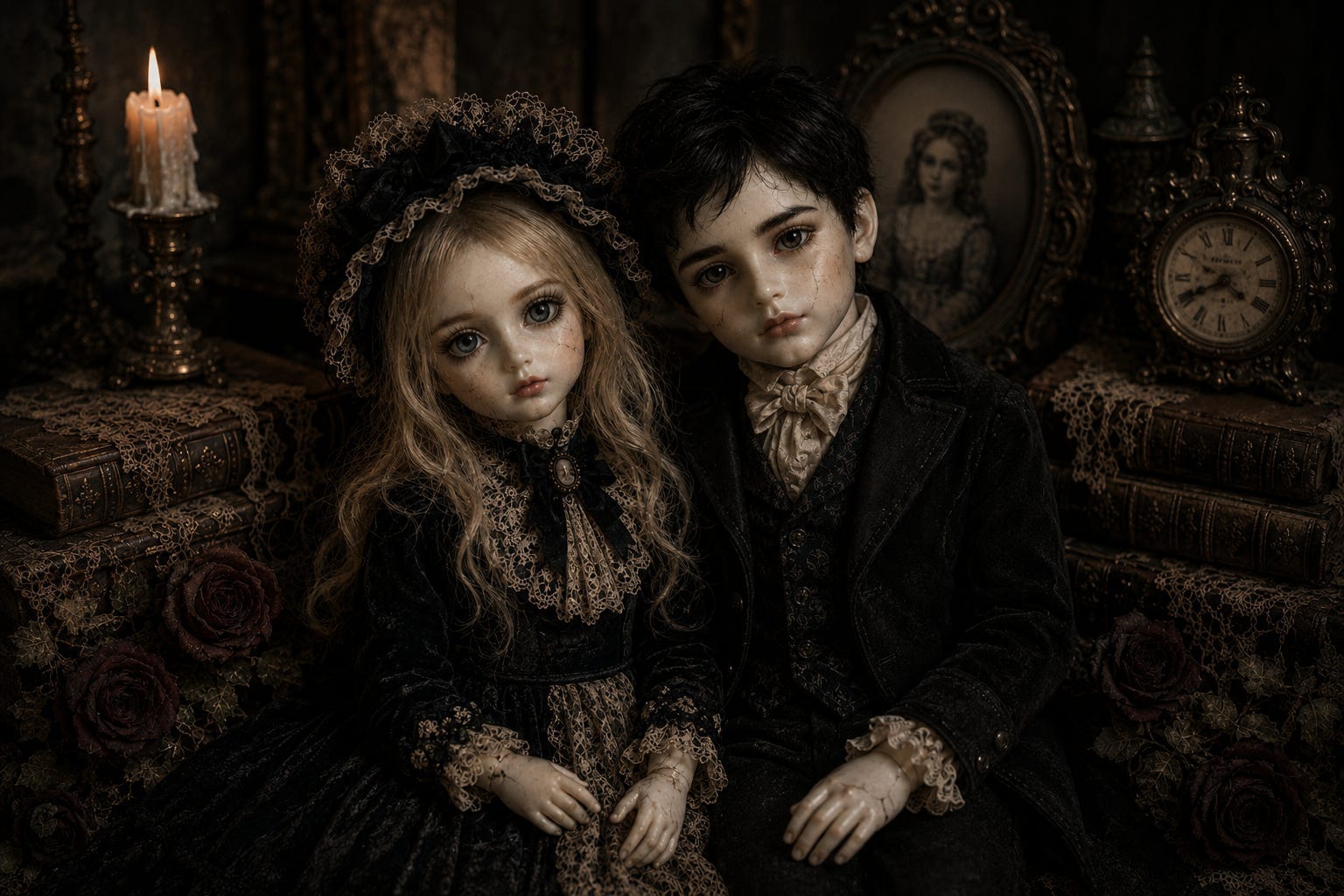
The attic breathed differently at night.
Old houses changed after dark. Wood softened beneath cooling air. Pipes spoke quietly inside walls no one living still understood. Rain moved across the roof in long uneven fingers while somewhere far below, the empty house settled deeper into itself.
Dust covered nearly everything.
Broken lamps.
Stacks of yellowed newspapers tied with fraying string.
Portraits turned backward against the walls as though someone had once decided the faces were better unseen.
The dolls remained where they had been left.
The boy lay inside a shallow wooden crate beneath folded blankets swollen faintly with the smell of cedar and mildew. One porcelain hand rested against the side of his face where the varnish had begun cracking with age.
Across the attic, near the round window beneath the slanted eaves, the girl sat upright inside a wicker chair no one living still remembered placing there.
Moonlight reached her first each night.
“Herman?”
The thought arrived softly through the dark.
A pause followed.
“Yes, Greta.”
Rain whispered against the roof above them.
The old house groaned quietly in the wind.
“Do you think we will ever die?”
Somewhere inside the walls, water ticked softly through ancient pipes.
Herman considered the question carefully, as he always did.
“I think we already did.”
“That wasn’t what I meant.”
He knew.
For a long while neither spoke.
Herman tried to remember the color of the room he had slept in as a boy.
He could still picture the window beside the bed. Frost gathering at its corners during winter mornings. Bare tree branches moving outside at night.
Not the color.
“I don’t know what this is, Greta.”
Moonlight rested pale and quiet across the floorboards between them.
Outside, branches dragged softly against the roof.
“I don’t want this forever.”
Herman wished, not for the first time, that he could move closer to her.
He remembered movement sometimes in fragments.
The feeling of turning toward someone while they spoke.
Crossing a room without thinking about it.
Wet sleeves thawing beside a stove after walking home through snow.
Certain memories returned with painful clarity while others disappeared completely. Once, for nearly seven years, he had forgotten his own last name.
Then one night it returned to him suddenly without explanation.
Snow muted the roof during winter months. In spring, rainwater moved noisily through the old gutters outside the attic window. Summers filled the space with heavy heat that settled into the wood long after sunset.
Then one afternoon the silence below them broke.
Greta startled awake, as much as a soul frozen within a doll’s body can startle.
A sharp metallic sound echoed faintly through the rooms beneath the attic.
A door opening.
Voices followed soon after.
A child. A small girl, perhaps six or seven, emerged through the attic hatch, her head appearing first. Her mother scampered after her, clattering more heavily on the attic stairs.
“Mama, mama! It's dark and scary up here.”
“Oh, no sweetheart. It's just a bunch of old junk that came with the house. Be careful—don’t touch anything. There might be nails or rusty metal. I don't want to have to go out for a tetanus shot.”
The girl now stood within view, her chestnut hair in pigtails which seemed to be catching spider webs like a duster. She wore a floral romper. Curious that those were back in style, Greta thought.
It had been a terribly long time since she had seen a living person. She counted herself lucky to see the errant mouse or spider.
“Herman! A family has moved in!”
The girl spotted Greta at once.
She squealed with delight.
“Mama! She's so pretty, Mama! But she's very dirty. Can I give her a bath?”
Before Greta could gather her thoughts, the child had already lifted her from the chair.
Movement.
Oh, Greta had forgotten movement. She took the opportunity to survey parts of the attic she hadn't seen in decades.
“Oh, Herman, I do hope they find you too.”
Greta’s befrocked porcelain form nestled beneath the child's arm. Greta felt the warmth of living flesh embracing her cold, hard skin. Such a strange sensation.
“Oh, Maisy. I told you not to touch anything!” the mother scolded.
The child sulked and hugged the doll tighter.
“If you must keep it, hold on to it while I go through the rest of the boxes. We can try to clean it later.”
The idea of a bath was almost more exciting than Greta could bear.
Decades of dust. Grime. Filth.
Washed away like sins by a baptism.
Greta heard a groan from Herman.
“Please, Greta. Please… don't leave.”
Greta ached for him. Tucked, as he was, beneath those blankets in the crate.
She feared they'd simply toss out the crate, with her beloved Herman inside.
She'd have held her breath if she had any.
And then, blessedly, the blankets were lifted.
“I don't know if these are worth washing or if they're simply trash,” the mother tutted, giving the blankets a sniff followed by a cough.
The girl noticed Herman before the mother could continue her excavation.
“Oh, mama! Mama it's a boy!”
She ran over, as her mother tried to slow her and warn her of potential dangers. She paid no heed, snatching Herman from his crate.
“They match! Mama, this is Timmy. And this is Janey. They're married.”
And then, in the most magnificent of moments, she pressed their faces together.
“Look, they're kissing!” Maisy squealed.
But for Greta, it was a miracle.
Greta felt Herman's porcelain cheek against her own. His touch, for the first time in decades.
She thought she might have wept, if dolls could cry.
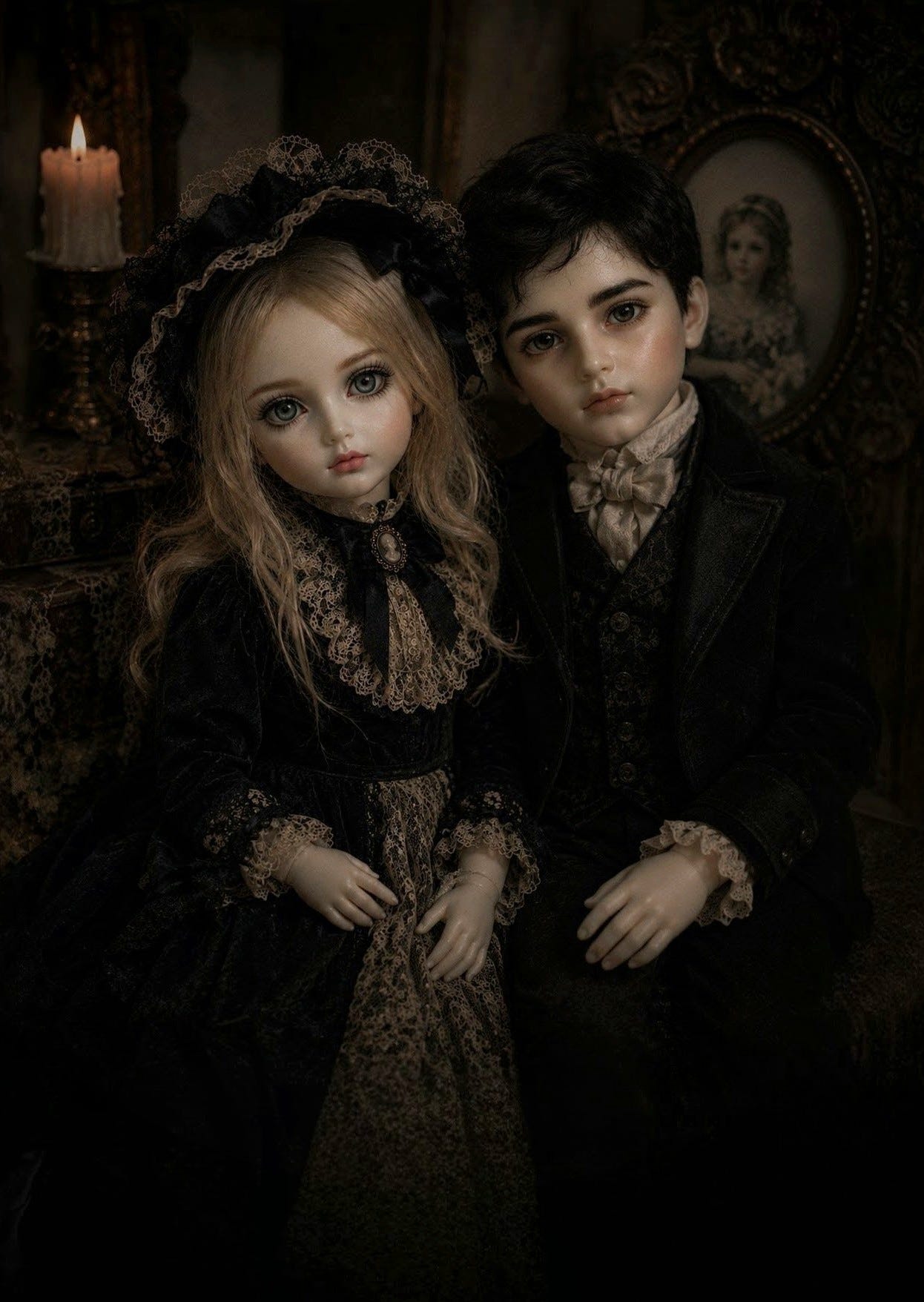
The bath was everything Greta had imagined.
Warm water soaked decades of dust from the tiny folds of her dress. A soft brush worked carefully through her hair while Maisy hummed to herself and spoke constantly, filling the room with the sort of meaningless details only the living seem capable of creating.
The neighbor's dog barked too much.
Her favorite color changed every few weeks.
She did not like peas.
A girl in her class had bitten another girl during recess.
Greta listened to every word.
By the time evening arrived she had learned more about Maisy than she had learned about some people during entire lifetimes.
Herman listened too.
The dolls now sat together on a shelf beside the child's bed.
Not touching.
Close enough.
The room felt impossibly alive.
Wind tapped softly against the window. A nightlight cast a pale amber glow across the walls. Stuffed animals occupied every available corner. Drawings hung from doors and dressers. Books formed uneven towers beside the bed.
Life left traces everywhere.
For the first few nights neither doll spoke much.
They listened.
The house itself seemed to have awakened.
Pipes rattled.
Floors creaked.
The refrigerator hummed somewhere downstairs.
People laughed.
Doors opened and closed.
Water ran through sinks.
Ordinary sounds.
Magnificent sounds.
One evening, after Maisy had fallen asleep, Greta finally broke the silence.
"Herman?"
"Yes, Greta."
"You're staring again."
The thought carried gentle amusement.
Herman had become fond of watching the child sleep.
Not in a sinister way.
More like a starving man studying a feast he had forgotten existed.
"I forgot how much noise living people make."
Greta smiled inwardly at that.
"Most people complain about noise."
"Most people haven't spent decades in an attic."
The moonlight coming through the window reached the edge of Herman's face.
For a while neither spoke.
Then Herman said quietly:
"I remembered something today."
Greta immediately became attentive.
Memories mattered.
They arrived rarely and left whenever they pleased.
"What was it?"
"I remember being hungry."
Greta was quiet for a moment.
"Was it unpleasant?"
Herman considered this carefully.
The moonlight had shifted slightly across the floor.
"I don't remember."
Another silence.
"I think the hunger was the best part," he said finally. "Not the bread. The wanting."
Greta said nothing for a while.
Maisy slept on, one small hand curled beneath her cheek.
"Herman."
"Yes."
"What is it you're wanting now?"
He didn't answer.
The nightlight hummed softly against the wall.
Outside, wind moved through the trees.
It wasn't until several days later, as they sat and waited for the family to return home for the day, that he spoke of it.
Sunlight lit the floating dust motes making the room look surreal—magical, even.
“I think…”
“Yes, Herman?”
“I think I want to live again, Greta.”
She laughed, then. She couldn't remember the last time she'd laughed. It echoed hollowly in her doll’s body.
“Don't be silly, Herman. We both want that. But it is impossible.”
“Is it?” he said softly.
Another long pause.
“If our souls could transfer into dolls, who is to say they couldn't transfer elsewhere?”
Greta considered this. He made a fair point, but she didn't understand the magic or miracle that had made them this way. And she didn't know where a better place for her soul would be.
The best places were already taken.
So she left it at that. It was nice to see Herman so keen and hopeful, for once. Best not to pop his balloon, as it were.
He didn't mention it again. Not for a while.
Life seemed pretty good to Greta. They had a child. They had laughter and activity and life. She got to see Herman. She got to be near Herman.
Sometimes Maisy even made them kiss.
That was always Greta’s favorite part of the day.
But then one day, the girl did not come home.
No one did.
Perhaps they'd gone on vacation, she thought.
When the child returned the mood was somber.
No playing. No smiles. No laughter.
Dark circles made her little eyes look hollow. She was pale. Her hair looked thinner.
Maisy asked for them, so the mother placed them next to her on her bed.
They stayed there, all together, for quite some time.
Maisy talked less now.
Greta noticed it first.
There had been a time when the child could fill an entire afternoon by herself. One question led to another. A story about school became an argument with an invisible pirate. An argument with an invisible pirate somehow became a discussion about whether dragons could survive on the moon.
The connections made perfect sense to Maisy.
That was all that mattered.
Now silence visited the room more often.
Not because the child had run out of things to say.
Because speaking seemed to tire her.
She still carried Timmy and Janey everywhere. She still tucked them beneath her arms when she slept.
The spaces between her thoughts had simply grown larger.
That afternoon she lay beneath her blankets watching dust drift through a shaft of sunlight near the window.
For nearly ten minutes she said nothing.
Then:
"Do you think Lily remembers me?"
The question arrived without warning.
Maisy continued staring upward.
"I bet she still has my purple marker."
A small smile touched her face.
"Actually, she probably lost it."
The smile faded.
A loose thread had worked itself free from the blanket. Maisy wound it carefully around one finger.
The room was quiet again.
After a while she lifted Timmy toward the ceiling.
"Do you think he'd be a good pirate?"
She considered the question seriously.
"No."
A moment passed.
"Probably not."
Another.
"You worry too much, Timmy."
The dolls were lowered gently back onto the blanket.
For a while nobody said anything.
When the bedroom door finally opened, Maisy's mother entered carrying a tray balanced carefully in both hands.
Greta barely recognized her.
The change had happened gradually. The woman seemed a little more tired each day, a little quieter, until the difference had become impossible not to notice.
There were shadows beneath her eyes now. Her hair had been gathered into a hurried knot that seemed to be losing an argument with itself. A few strands had escaped and hung beside her face.
The tray rattled softly as she crossed the room.
The first thing she looked at was Maisy.
The second was the dolls tucked securely beneath her arms.
The sight seemed to ease something inside her, though only briefly.
"How are Timmy and Janey doing today?"
Maisy's face brightened.
"They've been behaving."
Her mother set the tray on the nightstand beside the bed. A bowl of soup sat in the center, flanked by crackers and a fresh glass of water. Greta had begun to recognize the ritual.
Hope arrived on a tray now.
"They've been worried about me."
The mother's hands paused.
Just briefly.
Then continued straightening things that did not need straightening.
"Have they?"
Maisy nodded.
"Timmy worries too much."
For the first time that afternoon, a genuine smile appeared on her mother's face.
The kind that arrived before she had time to stop it.
"That sounds like Timmy.”
Maisy smiled and snuggled them close.
“I am very worried, Herman. I don't think she's getting better.”
The words echoed telepathically.
“I know, Greta.”
“I don't want to lose her, Herman. Finally, after all this time… do you remember how badly I wanted a little girl? Of my own? How we tried?”
There was a long silence, as though dust and cobwebs were being shaken off his memory.
“I remember.”
“This half-life felt like a curse, but maybe it is a blessing. Maybe the Good Lord in his wisdom knew I'd be needed. That we'd be needed. This is our chance for a family, Herman.”
“I don't think she's going to make it, Greta. I heard the mother say cancer. She said she doesn't have much time left.”
Silence.
“No parent should have to bury their child,” Greta whispered.
“What if they don't have to?”
Greta would have sniffled if her doll nose allowed for it.
“You can save her?” she asked, voice filled with desperate hope.
“I'm no healer, Greta. But I know a thing or two about magic. I apologize for getting us into this mess, sweetheart, but maybe I can find us a way out of it.”
Revulsion crept steadily down Greta’s neck. She didn't want to think about what he meant by that.
She couldn't.
“It's not for me, Herman. It's for Maisy, and her sweet mama.”
“Of course, love. Of course.”
After that, Herman didn't talk for a long time. But Greta sensed him. Watching. Listening. Plotting.
Greta shivered.
“Herman?” she asked, gently. “Why are you sorry? It was those crazy witch-folk that turned us into… this. Not you.”
A silence stretched almost unbearably long before he spoke again.
“Greta… I might not have been entirely forthright with you. You remember that traveling magic man? Well, he was acquainted with those occultists. They told me we could live forever. Immortality, Greta. And I wanted that. For us.”
If dolls could blink, Greta would have. Dumbfounded. She let this revelation sink in, down to the very depths of her soul.
And then—
She screamed. She screamed long and loud. The kind that would have shattered glass. The kind that rips your soul from your body. A psychic shriek that filled every corner of Herman's consciousness. A sound of betrayal and despair that broke the world.
Herman’s heart sank.
Then, there was only silence.
It wasn't until days later when Greta finally said, “How could you?”
Herman didn't know what to say.
“Let me try to make it better.”
“No! You've done enough!”
A few days later, Maisy was gone again. An ambulance had come to take her away.
“I… I hope she didn't…” Greta’s voice trembled.
Herman was grim.
“Hard to say. Suspect we'll know soon enough.”
“What will become of us? Will we be separated? Thrown away?”
“I don't know. Not if I can help it.”
When she arrived home, it was with tears in her mother's eyes and hospice flyers.
The end was near.
Her body looked so frail.
Broken.
Greta’s heart ached at the sight.
Her breaths came in small, ragged gasps.
And then, Greta heard it.
A song she'd long forgotten.
No.
God, no.
Not again.
A rhythmic chanting, coming from Herman.
“Herman! STOP! Leave her be!”
But he did not stop.
Maisy’s eyes closed and her breaths became very slow and spaced apart.
The chanting continued as Greta wept hopelessly.
Then the girl sat up and gasped.
The sound seemed to tear through the room.
Greta stared.
For a moment neither of them moved.
The afternoon light still lay across the blanket. The medicine bottles still stood in their neat rows on the dresser. Beyond the window, branches drifted lazily in the breeze.
Nothing had changed.
And yet everything had.
Maisy's chest rose sharply, then fell again. A trembling breath escaped her lips. Another followed.
"Herman?"
The girl's eyes shifted toward the nightstand.
Toward the dolls.
Toward her.
And Herman laughed.
Not because anything was funny. The sound simply escaped him. A startled, broken thing born from astonishment.
A moment earlier he had been trapped inside a body of porcelain and memory.
Now his heart hammered beneath his ribs so fiercely he thought it might break free.
His hand flew to his chest.
"Oh."
The word escaped before he could stop it.
The heartbeat answered beneath his palm.
He sat there smiling like a fool, feeling it thrum against his ribs while his fingers wandered across the blanket. The fabric caught against his skin.
Such a small thing.
Yet he found himself doing it again.
And again.
"Herman."
This time he looked toward Greta.
His smile was so wide it almost frightened her.
"I can feel it."
The bedroom door opened.
A woman stood there carrying a tray.
For a moment she remained motionless.
Her eyes fixed on the bed.
On the child.
On the rise and fall of a chest she had spent months watching disappear.
The tray rattled softly.
The woman crossed the room and lowered herself onto the mattress.
She reached for Maisy's hand.
Held it.
Said nothing.
Outside, somewhere beyond the window, a lawnmower droned through the warm afternoon. A dog barked. A car door slammed.
Life continued.
The woman bowed her head.
When she finally spoke, her voice sounded worn thin.
"I know you're tired, sweetheart."
Her thumb moved slowly across his knuckles.
"You don't have to keep fighting for me."
Herman felt her hand tighten.
The wonder around him faded.
Just a little.
He knew he should remain silent.
But the woman kept holding his hand as though it were the only thing keeping her anchored to the world.
His throat tightened.
The words arrived before he could stop them.
"I'm here."
The woman froze.
The lawnmower continued somewhere outside.
A bird landed briefly on the windowsill.
Neither of them noticed.
The woman's free hand rose slowly to her mouth.
Tears spilled before she could stop them.
And Herman, still feeling the warmth of her hand wrapped around his, finally understood that being alive was not the same thing as being alone.
The woman cried until exhaustion finally overcame her.
At some point her head came to rest beside the bed.
One hand remained stretched across the blanket.
Even asleep she seemed unwilling to let go.
Moonlight gathered along the windowsill.
The room settled.
For a while Herman listened to breathing.
The woman's.
His own.
The simple fact that he could hear both of them at once felt miraculous.
"Herman."
Greta's voice drifted through the darkness.
For a moment he thought he had imagined it.
Then:
"Herman?"
A smile touched his face.
Then a cough escaped him.
Longer than he expected.
When it finally stopped, his chest hurt.
He pressed a hand against his ribs.
"Herman?"
"You were saying something."
"You don't sound well."
He tried to dismiss it.
Another cough interrupted him.
This one bent him forward.
The ache remained after it passed.
"I don't feel good, Greta."
The silence that followed felt different.
Not distance.
Not yet.
The silence of someone deciding whether to speak.
Finally:
"I know."
The answer unsettled him.
"How?"
Greta didn't answer.
Herman's eyes drifted toward the dresser.
Medicine bottles stood waiting there.
Beside them sat the folder he had seen carried in and out of the room for weeks.
When he looked back at the arm resting atop the blanket, the answer was already there.
The sleeve had slipped back at some point.
The arm looked impossibly thin.
Blue veins traced pale skin stretched tight across bone.
Another cough shook him.
Hard enough that he tasted blood.
"Herman?"
Greta's voice sounded smaller now.
Farther away.
And suddenly he understood.
Nothing had changed.
The body was still dying.
Only now it belonged to him.
"Herman."
Greta's voice reached him again.
Fainter now.
As though she had taken a step backward.
Then another.
"What?"
A pause.
Then, faint as a memory:
"Don't stop listening."
He turned toward the nightstand.
Toward the small figure that had shared a century of darkness with him.
Toward Greta.
The coughing returned.
His chest burned.
Breathing became work.
The moonlight blurred around the edges.
"Herman."
He heard that one.
Barely.
The voice seemed impossibly far away now.
Closer one moment.
Gone the next.
As though she were being carried somewhere he could not follow.
"Greta?"
No answer.
"Greta."
A long pause.
Then Greta's voice drifted back to him.
So faint he almost mistook it for memory.
"I'm trying, Herman."
The distance remained.
Greta was still there.
He knew she was.
He just couldn't seem to reach her.
And for the first time since the attic, Herman found himself wanting something more than life.
He wanted Greta.
"Greta..."
The word never arrived.
His eyes found the nightstand one final time.
Found Greta.
Then darkness took him.
And from the nightstand Greta screamed his name.
Greta watched as the mother packed up Maisy’s things. It had been six months. She had counted.
Six months since she lost Herman.
Six months of a ringing silence she had never known.
She wondered where souls went when they died, and if she would ever get to join them.
She wondered if she would ever see Herman again.
That old fool. The love of her life.
And he was gone.
Maisy’s mother approached her, and picked her up.
She had already resigned herself to eternity in storage, or in a landfill somewhere.
“Oh, Janey.”
The mother cradled her, tears rolling down her face.
“Thank you for being with her. With my Maisy. She loved you so very much.”
Then they were on the move.
They passed the boxes. Through the hall.
A bedroom.
She was placed with care on the vanity. Her dress and bonnet straightened.
“We can miss her together.”
The mother stroked her hair.
Please be sure to subscribe to R.S.T., a true master of atmospheric writing. Check out his page here:

If you have enjoyed my work here in the labyrinth, please consider becoming a free or paid subscriber.
If you would prefer to make a one-time offering, you may Buy Me A Rose and I would be most grateful. 🥀
 | A guest post by
|
This was whimsy and sad and beautiful, great job!
Beautiful